I understand this pain point myself. I travel nearly full time with my family.
For now our kids are not of school age, but soon they will be.
What will our options be?
– A local school somewhere
– An international school
– Homeschooling
– An online school
– Hiring a tutor / tutors
– Group teaching with other parents / group homeschool arrangements
– Boarding school
– Unschooling
– A hybrid
We haven’t made a decision yet, but it’s definitely an on-going topic. And this is a recurring pain point my clients have when discussing moving internationally with a family. Some even leave Western countries because they don’t want their children to be exposed to government agendas.
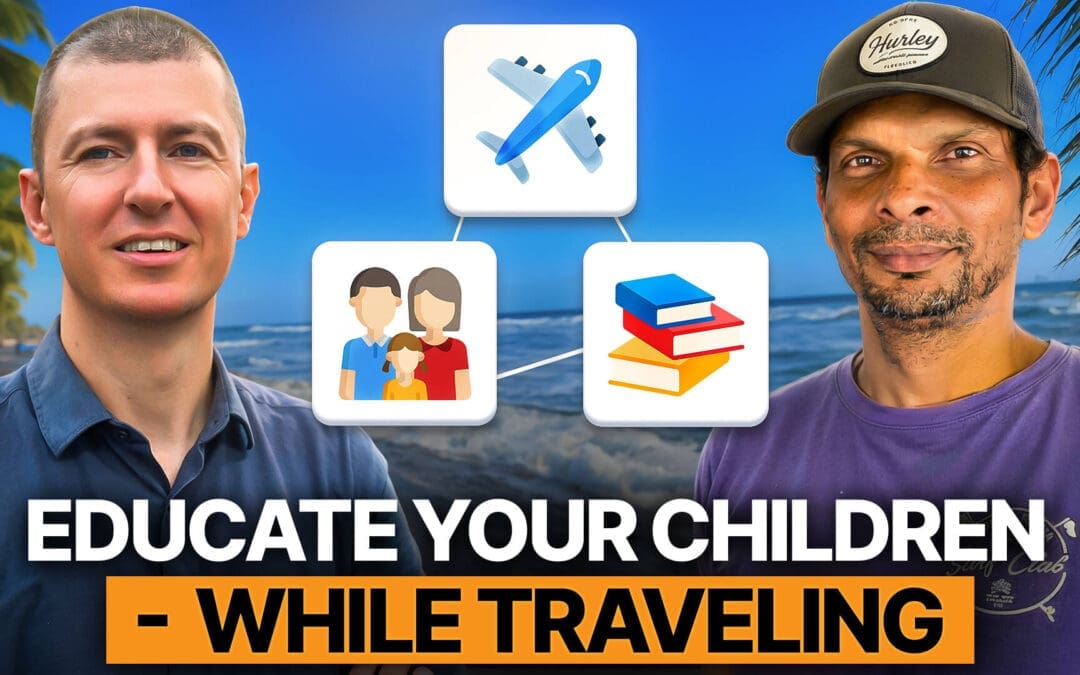
In this video with Andy, we explored the topic a bit. What he created is a homeschool hub in El Zonte in El Salvador with a focus not only on kids living full time in the area, but also on families that are in town for just a few weeks, with a particular focus on delighting surfer parents.
I love this type of entrepreneurial activity
Let’s face it, his school would not be a fit for 90% of parents on this newsletter, but that’s besides the point. More school options are appearing all over the world, especially in places where expats move to and that are less regulated.
I also like the fact that his school is profit driven. The goal is to delight clients. More Andys around the world see this growing pain point and are providing solutions in the market.
To a World of Opportunities,
The Wandering Investor.
Services in El Salvador:
- How to get residency in El Salvador
- Real estate attorney in El Salvador
- Real estate agents in El Salvador
- El Salvador Citizenship by Investment
Article on El Salvador:
- El Salvador Real Estate Market: 2026 Investor Guide – is it too expensive already?
- El Salvador’s Economy: The next Singapore or just another emerging market?
- El Salvador Homeschool Hub – Educating Your Children While Traveling
Subscribe to the PRIVATE LIST below to not miss out on future investment posts, and follow me on Instagram, X, LinkedIn, Telegram, Youtube, Facebook, and Rumble.
My favourite brokerage to invest in international stocks is IB. To find out more about this low-fee option with access to plenty of markets, click here.
If you want to discuss your internationalization and diversification plans, book a consulting session or send me an email.
Transcript of “El Salvador Homeschool Hub – Educating Your Children While Traveling”
LADISLAS MAURICE: Hello everyone, Ladislas Maurice of The Wandering Investor. Today we’ll be discussing a very interesting topic which is parents that get together in different locations in the world to organize their own schooling for their children. So we’re going to be discussing this with Andy here in El Zonte in El Salvador, who is in the process of starting essentially a homeschool or school.
Overview of the Homeschool Hub and surfer community
ANDY: Yeah, it’s called the Homeschool Hub. We’ve collected uh some great parents and some great students. We’re a surfer community, basically. So the school on the coast has specific needs.
ANDY: Number one, our programs can start really early and can start and can go really late. The dawn patrol program has surfers who want to come, drop off their kids and then go for early morning surf. So there are instructors there in the building and the kids that are your kids’ age that you can go for a surf and come back. Those same kids can stay for the program all day long.
ANDY: They can participate in the after school program, which goes till like 4:00. Uh the school is right beside a giant soccer field. So in the afternoons, there’s outdoor play, there’s art class and all kinds of cool stuff for the kids.
How do I educate my children while traveling?
LADISLAS MAURICE: I think this is really interesting because as people travel around the world and increasingly with their families, this is a one of the biggest pain points that families have when they travel around is, how do I school my children?
LADISLAS MAURICE: So back then, when you were an expat, it was pretty easy, you would just send your kid to the local international school. Typically it was quite expensive, but your your company that sent you there or the embassy that sent you to that country would pay for it.
LADISLAS MAURICE: But now this model is changing in a few different ways. One, people are traveling on their own, doing business, etc. Not everyone can necessarily afford the $30, $40,000 some of these international schools cost.
LADISLAS MAURICE: Two, some families are quite transient, so they travel around the world, they stay two, three months somewhere, then move on. So how do you accommodate schooling for your kids? And third, many parents don’t agree with the curriculum of what’s being taught in international schools. So, you know, back in the 90s and the early 2000s, education was pretty standardized. It wasn’t very controversial. But in the recent years with the culture wars, etc, a lot of these international schools are taking sides from an ideological point of view, and this puts some parents in a situation where, you know, the only international school in town is absolutely not aligned with their values, and the local schools are either poor quality, or the kids don’t qualify, or they don’t want to send the kids into a school in a completely different foreign language.
LADISLAS MAURICE: Increasingly, parents are getting together and trying to find solutions, and also other people are trying to make a business out of it because it’s clearly a business opportunity.
LADISLAS MAURICE: So what you’re saying here is is quite interesting. I mean the surf angle is is completely unique. But you’re addressing a market need.
ANDY: Yeah, because El Zonte is not just surf. Correct. Elzonte is quite unique in the sense that it was one of the hubs of Bitcoin really, where the whole Bitcoin is legal tender in El Salvador started, even though it ended recently, but it’s still, I mean, every single shop here in El Zonte accepts Bitcoin, everyone accepts Bitcoin. So you have a lot of crypto people, a lot of libertarians, a lot of tech optimists who come here with their kids. How do you make that match with the surf aspect? Because it’s they’re very different. How do you manage this?
Decentralized education as an ideology
ANDY: Yeah, you know, the ideology behind decentralized finance is very, very similar to the ideology behind decentralized education. You hit the nail on the head when you said that um there are a lot of folks who are disenfranchised and not really liking the way academia is going these days. Uh they want to pull their kids from programs, homeschooling is at an all-time high right now in the United States and in Canada.
ANDY: Um people are leaving those places for tropical destinations and illegal in in many parts of Europe. So, you know, even if parents do not want to put their kids in the government school system in many European countries, people do not have the choice. They have to do this. If they don’t do it, then social services show up.
ANDY: Yeah. Uh I don’t know of any law in this country like that. As far as I understand, the government wants to know that everyone is being educated and they they don’t have a particular legislation like a truancy rule or anything like that that I’m aware of.
ANDY: But the trend is to take your uh your child’s education into your own house. And so the name Homeschool Hub, it’s a little bit sounds like a bit of a hypocrisy because what is it? Is it your home or is it a hub? What is it? It’s a good it’s a good question.
ANDY: Yes, we do homeschool programs, but yes, it is a a place where you can uh bring your child. Say if you’re here in El Zonte for two weeks, say if you’re here for two months, uh your child can continue its uh his or her program in our school.
How do I enroll my child in Homeschool Hub?
LADISLAS MAURICE: So concretely, so you’ve got one side of the school, which is the the year-long program for families that are that live here full-time.
ANDY: Absolutely.
LADISLAS MAURICE: Let’s say I come with my kids um and I want to hang out in El Salvador for six weeks.
ANDY: How old are your kids?
LADISLAS MAURICE: Let’s say when they’re a bit older. That’s relevant. Let’s say when they’re, you know, seven or something.
ANDY: Okay.
LADISLAS MAURICE: I come for for six weeks. How does it work concretely? I I come to the hub, I come to the to your school. What do we do for for six weeks? How does it work? Do do your teachers ask for my materials? Like how does it work concretely?
ANDY: So, uh your question falls into two categories here. One, everyone is interested in the curriculum and accreditation. So what’s the curriculum and how is it accredited?
ANDY: So the curriculum is my school is project-based. So kids are always working on a project. The project reflects their wants and needs from the real world. Uh I’ve got the parents involved, they’ve got their vocations, they got their the things that they love, and they come in for TED Talks and teach the kids what they know, and the kids derive a project from the parents. And so the parents are well involved with what the kids are doing. That’s what we want. We want parental involvement. We want the the parents, because there’s a study that we talked about before we started rolling the cameras is that the children have a little more respect for the friends’ parents than sometimes they do for their own parents. So we want to capitalize on that and have the parents come in. So the parents will teach some of the curriculum, the staff and the the instructors and the teachers will teach another bit of the curriculum. So your kid who arrives will jump into the curriculum.
How does accreditation work for learning centers?
ANDY: So accreditation, accreditation is basically the transcripts. Transcripts are what class material that they’re learning and their absentee record or their attendance record. So that’s what the schools want to see. Uh what are you learning and how many days did you do? So we have a program that records all that and so uh if you as you leave the school, here’s your transcript. Here’s what you did. And some students get into post-secondary schools with these transcripts alone. I’ve been told uh by some of my mentors and guides who’ve been doing the mentoring and homeschooling for many years. Um it is not necessarily required that you always have an official accredited school uh with official accredited hoops that you jump through. Now, our school does offer that. We are in talks and negotiations with a school from Washington State in the US. They are offering their accreditation. I want to see exactly what they’re teaching in their program. What hoops do you want us to jump through? Is is there a cost for us? So I don’t need to follow their uh guidelines. Um one of the good and bad things about having an accreditation with the school is, one, if you’re labeled a school, which we’re technically not, we are a learning center. If you’re labeled a school, then when holidays come around, you have to close.
ANDY: And then you’ll take a summer vacation. So regular schools are limited to 180 days per year. Mhm. Our school can be open 240 days a year. That’s a lot more days. This means that our children in our program can learn a lot more faster in one year, meaning over the course of their years with their school, they have the ability to fast track through the system. Uh like I said, accreditation and the transcript accurately record how many days and what courses you’ve done. So with more days per year, we can accomplish more.
ANDY: And also specifically people come here for the holidays. So they’re here for Christmas break. If our school closed at Christmas break or closed at uh Thanksgiving break or whatever, that’s an opportunity. People want to have their kids involved in some activity during those holiday seasons. So that’s what we plan to do. Of course, I’m going to rotate my staff in and out so they get their time off, but I want the facility to be open and available during the holidays for uh for students, for sure.
LADISLAS MAURICE: Look, this is fascinating, Andy. Thank you very much for for sharing and it’s good to see that parents are taking matters into their own hands and we’re seeing grassroots movements like this all over the world. Um the situation now is still a bit complicated, but thanks to Andy and people like him all over the world, it’s going to become increasingly easy, I think for parents who travel a lot to find solutions for their children because not everyone can just has the capacity to sit at home and and teach their kids. It’s a part-time job and not everyone is meant to be a teacher realistically.
ANDY: We all need help and support from people who have done it before. I am finding individuals who have started schools in the tropics in the past and who have been very successful in that. And so I want to hire the best staff possible.
Impact of weather on school schedules
LADISLAS MAURICE: Why are you highlighting in the tropics?
ANDY: Essentially, it’s the heat. When it gets hot in the afternoon, people do different things. In North America, it gets great in the afternoon. Everybody wants to be outside. So, uh the idea is, let’s get the kids cozy and warm inside the house during the morning. This is North America. Let’s get the kids cozy and nice and warm inside the house in the morning when it’s chilly outside. Lunch rolls around, it’s hot, kids can play in the sun. In the afternoon, it’s probably the best time to be outside, right? Cut to the tropics. Here at dawn, the temperature is the best. It’s not too hot, not too cold, the sun hasn’t come all the way up yet. Outdoor activities are best 8:00 a.m. to 9:30, 10:00. You want to be outside there. It’s really easy, not sweaty, not hot. As the afternoon comes on, flee to the indoors, take your afternoon nap. That’s the normal flow of the day. Go to someplace cool for your lunch hour, right? And certainly for the afternoon, seek out some ACed area, some indoor space. We have that uh uh for our school. So the idea of how the curriculum flows is very important to the climate, for sure.
How to contact Andy about Homeschool Hub
LADISLAS MAURICE: Fascinating. Thank you very much, Andy. So there is a link to Andy’s website in the description below of the school here in El Zonte in El Salvador. And if you’re interested in moving here to El Salvador, I wrote a whole report on the real estate market as well, the pros, the cons, the cities that are interesting, the places you should avoid, taxes, etc. So full investor guide for the El Salvador real estate market, and there’s a link below as well. Andy, thank you so much, hey.
ANDY: You’re welcome. You’re welcome. It’s the Homeschool Hub, Hschoolhub is the website and uh you can see it at the bottom and check us out.
LADISLAS MAURICE: Make sure to download my free ebook 12 mistakes to avoid when investing in international real estate, which you can find on my website, link below. And feel free to follow me on Instagram at the Wonder Investor. I look forward to hearing from you.