

I am very bullish some parts of Africa long-term.
While Europe, the U.S. and the Middle East are hurling missiles at each other and destroying infrastructure, Africa is building.
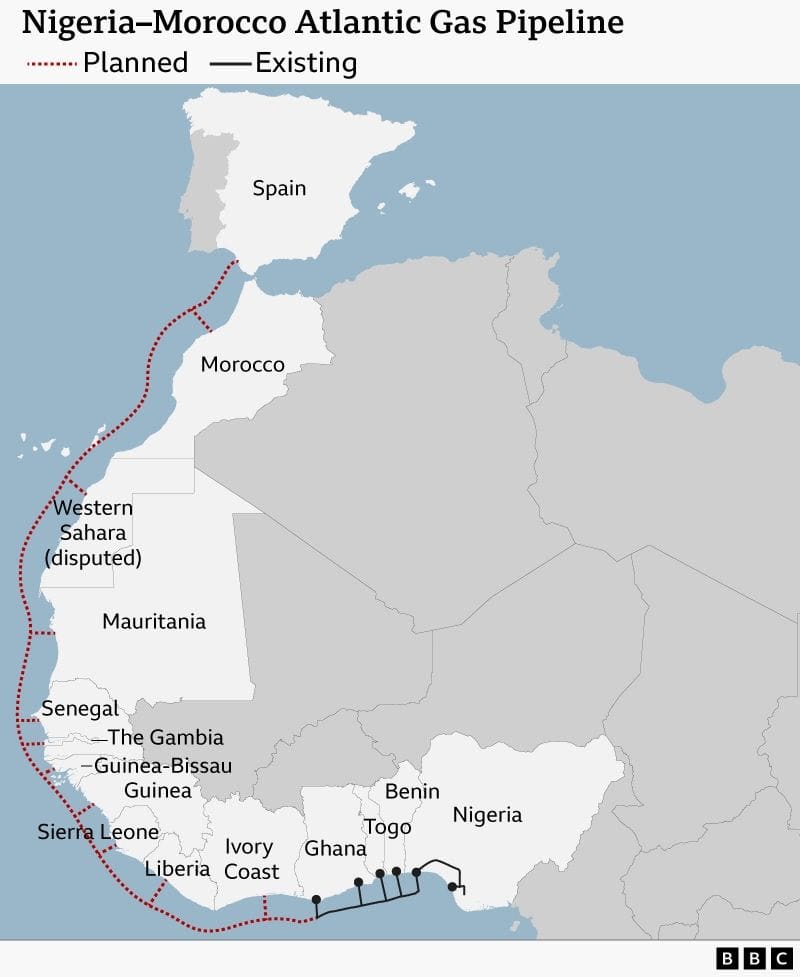
1. A $25 Billion gas pipeline from Nigeria to Morocco / Spain has just been announced with access for all countries along the coast.
Cheaper and readily available energy for all. Construction is to start from 2028, but obviously delays can be expected.
2. Two weeks ago while I was doing research on land and Swahili stones houses on Lamu Island in northern Kenya, big news was announced.


This is huge. Kenya keeps firing on all cylinders. Just look at the local stock market.

Kenya will keep growing and gaining importance as East Africa’s hub and increasingly as Africa’s prime investment destination for corporations to set up their Africa operations.
I spent most of my twenties in Africa, and I intend to allocate a significant share of my future decades to the continent to capture such growth.
As part of this strategy I just bought a lifestyle 3-bedroom 3-bathroom apartment for my family in one of Nairobi’s best neighborhoods.
Real estate in Nairobi is the cheapest livable capital city real estate that I can think of.
I paid $115,000 for a large 3-bed, 3-bath apartment with a rooftop heated swimming pool, a restaurant, a co-working space, kids area, parking, sauna, etc with a 2.5 year payment plan.
The value for money is amazing. There are even one-bedroom apartments starting from $46,000. This pre-construction deal won’t last forever.
In this video I compare 4 projects I considered investing in.
Africa is not perfect
I can already imagine some among my followers gleefully snickering the next time something bad happens in Kenya.
Will there be issues and violence during protests or elections? Sure.
Will the country at some point require some sort of IMF bailout? Almost certainly.
Will the country get hit hard if there is an energy crisis driven by all the crazy people? Absolutely.
But guess what, the country’s march forward is unstoppable; two steps forward for every step back.
Feel free to get in touch with my Nairobi realtor Pratik if you have any questions about any of the projects or wish to get the pre-construction price list.
Feel free to read the Nairobi Real Estate Investor Guide.
To a World of Opportunities,
The Wandering Investor
Services in Kenya:
Articles on Kenya:
- Nairobi Real Estate Market: Investor Guide 2026
- Outlook for investing in African Stock Markets in 2025
- I bought 3 apartments in Nairobi
- High returns on Nairobi real estate – 3 case studies with ROI calculations
- Why are Chinese Real Estate Developers Moving to Africa?
If you want to read more such articles on other real estate markets in the world, go to the bottom of my International Real Estate Services page.
Subscribe to the PRIVATE LIST below to not miss out on future investment posts, and follow me on Instagram, X, LinkedIn, Telegram, Youtube, Facebook, and Rumble.
My favourite brokerage to invest in international stocks is IB. To find out more about this low-fee option with access to plenty of markets, click here.
If you want to discuss your internationalization and diversification plans, book a consulting session or send me an email.
Transcript of ” I Bought an Apartment in Nairobi, Kenya, For My Family”
LADISLAS MAURICE: Hello from beautiful Nairobi in Kenya. I am buying an apartment for my family. I like Kenya a lot, I love Nairobi and I want to spend more time here, but I want to spend time with my family. So we’re going to be using Nairobi as a base for when we go around Africa for business and travel, etc. I already bought a few investment properties here in Nairobi, but this is different. This is not about the numbers. This is about essentially lifestyle and just being happy here. So we’re going to have a look at four different projects that I considered the pros and cons of each for a three-bedroom apartments. And then I’ll explain why I chose the specific building I’m going for. All right, let’s go. All right, but first things first, I need to get on a boda because I am late.
LADISLAS MAURICE: Yep, in front of the building, yes. Okay, what’s your number ?
ISAAC: 0704
LADISLAS MAURICE: Isaac.
ISAAC: Yeah, Isaac.
LADISLAS MAURICE: Okay. Okay. All right, thank you, boss. Take care.
Visiting the construction site of my investment apartment in Nairobi
LADISLAS MAURICE: All right. So this is the first building. I already bought four apartments here, but just pure investment properties, one bedrooms and one and a half bedrooms from Alex. Alex, how are you?
ALEX: I’m good.
LADISLAS MAURICE: Always a pleasure to see you.
ALEX: Pleasure to see you again.
LADISLAS MAURICE: I remember when I first bought, uh, you didn’t quite have the permits, but now clearly you have the permits.
ALEX: Of course. Even the structure is done.
LADISLAS MAURICE: So are you on track with the timelines?
ALEX: Yeah, yes. Actually, our schedule is to complete the structure by end of June. We have made it on the first week of June.
LADISLAS MAURICE: Okay. So you had one bedrooms, one and a half bedrooms, two bedrooms plus studios, three bedrooms, four bedrooms, but the smaller units have all sold out.
ALEX: Yes, smaller units are all sold out.
LADISLAS MAURICE: Is this something Pratik that you see when in a lot of developments that the smaller units sell faster?
PRATIK: Yes, definitely. The smaller units do go much, much faster. And uh mostly like pre-construction or just when construction begins.
LADISLAS MAURICE: Yeah. So really to preface this video, I think it’s important for people to understand, when you buy a three-bedroom or four-bedroom apartment in Nairobi, it’s not about rental yield, okay? You’re not going to buy a three-bedroom or four-bedroom and make a ton of money on Airbnb. That’s not quite the market. It’s really about buying something for yourself, uh, for when you come into town to live or, you know, if you come here a few months of the year, you have a place. The rest of the time you can put it on Airbnb, make a bit of money, etc. But the primary focus is not making high yields. It’s lifestyle and then long-term capital appreciation. But you still have some of the three and four-bedroom apartments that are available.
ALEX: Yes, some of the three and four are still available.
LADISLAS MAURICE: Okay, cool. So we’re going to go to the showroom and then I’ll explain why I am not buying these apartments. All right, let’s go.
ALEX: Safety first.
LADISLAS MAURICE: Yep. Okay.
ALEX: We have three-bedroom plus DSQ plus study and four-bedroom plus DSQ. The price range from $180,000 to $220,000. So this is the big sitting room and dining area. We have a separate kitchen. The DSQ is outside of the kitchen. This is the first bedroom, which is in suite.
LADISLAS MAURICE: Pratik, can you explain to people who aren’t all aware of what a DSQ is?
PRATIK: So DSQ is for like your maid or driver or somebody like that who can stay here or use the space and it can be enclosed with a separate exit.
LADISLAS MAURICE: Yeah. So some people use the DSQ for help, other people use it just as storage, other people make an extra bedroom out of it. Other people just actually storage when they leave and they put it on Airbnb. So they just put all their stuff in the DSQ, they lock it up, and then they can put the whole apartment on Airbnb, which is uh, which is pretty nice. All right, so huge, I mean, this place is huge. What are the square meters, Alex?
ALEX: Uh, it’s around 225 square meters gross area.
LADISLAS MAURICE: Okay.
ALEX: So this is the study room I mentioned about. Uh some client may also use it as a as another bedroom. This is the washroom, which is in suit for this guest bedroom. Here we come to the master bedroom with a huge bathroom.
LADISLAS MAURICE: Very nice.
ALEX: Spacious space and a balcony outside.
LADISLAS MAURICE: Very nice. It’s good to see a bathroom with a tub, not just a not just a shower.
Differences between Kenyan and European real estate markets
LADISLAS MAURICE: So, uh Pratik, can you elaborate a little bit on the difference between gross square meters and net square meters? Because a lot of people who come into the Kenyan market don’t quite get this. Yeah.
PRATIK: So primarily in the Kenyan market, we use gross when we talk about square meters. Uh and I know you were saying in the European market they use net. So the difference between gross and net would be the inclusion of the walls, the staircase, items like that. Uh and uh in terms of gross uh cost per square meter, it’s about $1,000 or a bit less, and in terms of net cost per square meter, it’s about reaching $1,200.
LADISLAS MAURICE: And Alex, can you tell us the amenities?
ALEX: Of course. We have a heated swimming pool, a nice apartment. We have a fully equipped gym. We have a sauna area for men and ladies. We have a indoor children play area. We also spent the $100,000 of dollars on the landscaping garden design. So in the future when we hand over, it will see a very beautiful garden.
LADISLAS MAURICE: Look, um, less than $1,000 gross or about $1,100, $1,200 net for a big apartment in the best neighborhood in a growing city, in a growing capital city like Nairobi, here in Westlands, with all of these amenities, brand new. I mean, by global standards, this is dirt cheap. I mean, I can’t really think of many other capital cities in the world where you can get such value for money. It’s really incredible.
Why am I not buying more apartments in this building?
LADISLAS MAURICE: So now you’re probably wondering why am I not buying in this building? And I know we’ve been having a lot of back and forth over the past over the past year. It’s like, oh, I want to buy something. Then I’m like, oh no, the reality is I’m buying four apartments. My wife is also buying an apartment here. So we’re already at five apartments in this development. I know I preach a lot about diversification and we just felt that being all in a single development was a little unreasonable. But I was still thinking about it, I was still considering it. And then when you told me you came up with the new project, then yeah, then I just immediately bought in this new project. So we’ll go to the next project. That’ll be the third project. Right now we’re going to go check out another one. Then we’ll go check out his new project and we’ll look at the pros and cons of that one. All right, let’s go.
Who is buying apartments in Nairobi, Kenya?
PRATIK: So Alex, at this development that we just saw, what percentage of the clients are foreign versus Kenyan?
ALEX: Kenyans are around almost 70%. Foreigners are around 30%.
LADISLAS MAURICE: It’s interesting to see that there’s this much uh purchasing power locally. It’s a good sign. And how many of the Kenyans are diaspora versus local local?
ALEX: Maybe 60% local local. Then 40% diaspora.
LADISLAS MAURICE: Okay. So about half is Kenya Kenyan money and half is overseas money, whether foreign or Kenyan?
ALEX: Yes.
LADISLAS MAURICE: Pratik, is this something you see as well in other developments where about half of the money comes from overseas and half locally?
PRATIK: Yes, definitely. And it’s getting more and more as well. And you can clearly see there are more and more visitors into Kenya as well, along with diaspora coming back.
Visiting building with duplex apartments in Westlands in Nairobi
LADISLAS MAURICE: All right, so we just got here. Alex was not aware of this project. It’s clearly going to be a competitor project. Uh Alex was just on the phone right before here. Cool. So tell us about this project.
PRATIK: So, duplexes on, in a very prime area in Nairobi. We’ve got three bed duplexes at $183,000. You’ve got two bed duplexes at $143,000 USD. You’ve got one bed duplexes with a loft at $75,000 USD.
LADISLAS MAURICE: Okay. So I was considering the three-bedroom duplex, but the problem is I just took a step back. I like the project. I don’t want stairs inside my apartment. I have small children and it just adds drama. I just want a flat surface. Can you talk about the amenities?
PRATIK: So we’ve got a rooftop paddle court, uh which is always good. You’ve got a rooftop heated swimming pool, got gym, sauna, steam, there’ll be a co-working space, amongst other amenities. So it’s got the usual amenities plus a bit more of what these Nairobi developments are offering.
LADISLAS MAURICE: We’re still in the Raphta area. Um Alex’s project is right behind and the first one that we saw with Alex is the big project behind being built.
PRATIK: Yeah.
LADISLAS MAURICE: Are there also studios?
PRATIK: Yeah, so uh as you can imagine, or you can’t imagine, there’s studios for $35,000 USD. There is one bedroom, which is slightly bigger for $50,000. Uh imagine that in a capital city.
LADISLAS MAURICE: Look, when you usually hear of cheap studios and, you know, you’ll end up in some like in Batumi, in Georgia, like just like very uninteresting places or some, you know, some far-flung area and like, you know, Asunción. Like here you are in the heart in Westlands, in the heart of a dynamic capital city, dynamic economy, and you’re getting a brand new studio with a rooftop paddle court, swimming pool, etc. For just $35,000. It’s quite ridiculous. But the pre-construction sales have not started, right?
PRATIK: No, they will start in about a month’s time and it will go from there.
LADISLAS MAURICE: Okay, cool. So if you’re interested in just being on the waiting list, just shoot Pratik a message, and now we’re going to go check out the building where I’m buying.
Visiting the construction site where I bought an apartment for my family in Nairobi
LADISLAS MAURICE: So Alex, tell us about the project.
ALEX: This is our new project. We are going to start maybe in a three to four months time. We’re going to have one bedroom around 59 square meters, price range from $46,000. One bedroom plus multi-purpose room, 71 square meters, price range from $62,000 and the two-bedroom plus studio around 144 to 149 square meters. Price from $115,000.
LADISLAS MAURICE: Yeah. So I saw this and initially, I mean, the prices are quite incredible. Those are pre-construction prices. You even have the full permits or not yet?
ALEX: Not yet.
LADISLAS MAURICE: Okay, cool. Yeah. So I think let’s explain this to people because last time I bought from you, you also didn’t have the full permits. So can you explain how you structure things in a way that people get the pre-construction price. So the really attractive price. I mean, here we’re looking at $1,000 per net square meter. This is, this is quite ridiculous with a payment plan over how long?
ALEX: Around from now around two and a half years.
LADISLAS MAURICE: Okay. So $1,000 a square meter net and you can pay over two and a half years. So how do you ensure that my money is safe when I buy now and you don’t have all the permits?
ALEX: Actually, we are already got the county approval. We also uh get the both the structure and architectural approval. We are waiting for the NEMA approval and the NCA. So currently we have started the design. Actually, the design is already done. So just waiting for the approval to be complete, we can start the project. That’s why now we open the for sale for booking, actually. Uh so the client who come earlier can enjoy an early bird price. First, we only request you to make a booking fee. For the one-bedroom and the one plus multi-purpose room, uh the booking fee is 500,000 shillings, which is around three and a half thousand dollars. Yes, $3,000 something dollars. Then for the two-bedroom plus studio, we request $1,000,000 shillings, which is around the $7,000 to $8,000. Then once we start, then you will be requested to pay the full deposit, which is 20%. Uh after that, we will sign the official agreement, then you can pay the balance on a quarterly basis. Of course, as what we usually do to make your feel safe, every month, we will uh make a monthly progress report to all of our clients. Once you see the progress, the project is moving, then you will keep paying the installments.
LADISLAS MAURICE: Okay. So now you’re probably wondering, I’ve been talking about three bedrooms, but there’s no three bedrooms. So what I’m doing is I’m actually putting a door between the two-bedroom and the and the studio. So two-bedroom plus studio is an interesting unit for investors because you get both the two-bedroom and a separate studio with separate entrances, separate meters. But I’m just turning it into one big apartment. The studio, I’ll turn into a big master bedroom with walk-in closet, you know, instead of a kitchen, just a walk-in closet, a big bathtub, uh shower, etc. So a really nice, nice big master bedroom. It’s a little strange to do this, but the reality is $115,000 for a three-bedroom, three-bathroom apartment here is just such a steal. It’s hard to say no to something like this. Can you talk about the amenities?
ALEX: In this project, we have more amenities. We’re going to have of course a heated swimming pool and it’s going to be a rooftop infinity pool. It’s going to have a fully equipped gym. We also have co-working space on the mezzanine. We have a coffee shop. Of course, we have sauna. We have a indoor children play area. All the amenities we have in our previous project we’re going to have. And then here we also increase the like the coffee shop, co-working area, those uh amenities.
LADISLAS MAURICE: Yeah. So look, what I like about this road specifically is that it’s super quiet and also it’s safe in terms of views because it’s a corner it’s a corner lot. So there won’t be like a building right next to it. When they start building here, for example, here there’s a vacant lot, eventually someone will start building, but it’s fine because there’s a road in between. Same thing with the building in front. You know, there there’s a road in between so there’s space, there’s sunshine. And then the higher floors definitely have like full uncovered views of the valley because it goes down. So I’d like this area a lot. I mean, the other project has a paddle court, but this one does not. But literally here, I mean, that’s a paddle court, a private paddle court. So if you really want a paddle court, you just walk two minutes and you have one there next to the organic shop. Pratik, do you have a lot of projects like this at $1,000 a square meter in such a central location with such amenities from a reputable developer that has a track record? How many developments have you done now?
ALEX: Uh this is the eleventh one.
LADISLAS MAURICE: Eleventh one. Okay. So like good track record.
PRATIK: I mean, at $1,000 net cost per square per square meter and this being pre-construction, it is a very rare deal. Uh I mean, you’ve got a spectacular development from somebody with a good track record, an extensive know-how of the Kenyan market, which is uh I would say a really good deal.
LADISLAS MAURICE: Yeah. So his other development, the first one, the units are a lot bigger, obviously. Um they were around, you know, $1,200 per square meter net. Here it’s $1,000 but it’s pre-construction. There it’s almost finished. You know, the project is pretty much de-risked. So they’re very different. You know, if I were to live here full full time, I would probably go for the other apartment because there’s more space. But because I plan on using this kind of in and out, and then when I’m not around, put it on Airbnb, this just works just perfectly. So I’m really happy with the with this deal. All right, so just get in touch with Pratik and Alex if you want to get the full price list. And now we’re going to go see the project that had my heart, but I just could not afford. All right, let’s go.
Chinese developers in Nairobi, Kenya
LADISLAS MAURICE: So Pratik, there are a lot of Chinese developers here, eh?
PRATIK: Yeah, and as we’ve been discussing, more are even coming. But uh what’s interesting is uh more and more they are sourcing their raw materials and products locally as opposed to before when they first came in, they were importing majority of what they were using. And that’s good. I mean, it shows and you can see as well with the infrastructure growing, the amount of industry growing as well. Some of the big steel companies and other companies actually have Chinese sales reps on there.
LADISLAS MAURICE: And they’re not like Chinese companies?
PRATIK: No, they’re local companies. They will have their Chinese sales reps which will make business for them easier and uh much more smoother. Yeah.
LADISLAS MAURICE: Interesting. So like what are examples of things that were before imported from China that are now produced locally?
PRATIK: So you’ve got things like the steel. Things like cement were always procured locally, but mostly to do with steel and also finishing. A lot of the finishing were before fully imported, and now you see more and more of them buying it locally as well.
LADISLAS MAURICE: That’s great. It just means the economy is becoming uh more sophisticated, the economy’s growing. It’s creating local jobs, local employment. I mean, this is good news for everyone here in Kenya. Yeah, so people are very quick to criticize the Chinese and say that they’re doing horrible things all over Africa, etc. Look, not everything they do is perfect, obviously. But you just have to bear in mind that a lot of it is just anti-Chinese propaganda. The Chinese are coming here, they’re doing business, they’re the number one builders of infrastructure across the continent, and they’re very much open to trade. China offered access to its markets entirely duty-free to the entire continent of Africa, and that, you know, the same cannot be said of the European Union and of the United States and, you know, Australia, Canada, all these places. On the one hand, you’ve got Western governments that are always lecturing about how terrible the Chinese are, but then are then, you know, lecturing local governments on what to do, what not to do, that then don’t give access to, you know, their markets. And the Chinese just come here and just do business and offer free trade. So, you know, sure, they’re not perfect and sure, you know, West is not all bad. The situation is just a lot more nuanced, just like with everything else. There’s a lot of propaganda on all sides. When I see a bunch of Chinese people landing in a country, overall, it’s still, generally speaking, a lot more positive than negative for the country.
Checking on my investment in Chinese development in Nairobi
LADISLAS MAURICE: All right, so we’re going to go check out that fourth project, but on the way, we’re stopping here at the other project that I bought in from Mrs. Lee and Betty. But this one also pure investment, not lifestyle. Why did I buy here? We’re in the heart of the GTC. It’s effectively the new central business district of Nairobi. The malls around, the hospitals, the nightclubs, the bars, the restaurants. So this is here I’m targeting typically African businessmen who come for business, they want to work hard, they want to play hard. And that’s my target market, so it’s obviously not for my family. One of the reason why I chose this specific development is because Mrs. Lee and Betty were brand new on the Kenyan market, which means the people had initially low trust in their development because they’re new. But whilst doing due diligence, we came across the fact that they’re actually a big developer back in China. And then we had this discussion and then you explained that you had to price yourselves at the same levels other Chinese developers, but that to build your reputation, you will you would build higher quality. So effectively, I’d get a I’d get a discount in that I pay for normal quality, but I’ll get higher quality. So can you elaborate please on what exactly you’re doing to deliver that higher quality compared to other developers?
MRS. LEE: So everyone was saying, “How come the speed is so fast?”. For our company, we have always kept track of the progress of our products. We prioritize the quality and safety of our products. Why is our project progressing so quickly? Because our foundation work, including the complete implementation of the zero-level design, has been completed. This was completed just in five months. In Kenya, many projects, especially the vast majority, require six months (180 days) for foundation work. We completed twice that amount of work in five months. With construction proceeding so quickly, can the quality be guaranteed? Our general contractor once told me that the design and construction requirements were the highest he had encountered in his over ten years of construction work in Kenya. We strictly adhered to Chinese and international standards for high-rise buildings in the design phase and maintained strict control during construction. They all say that the foundation of our solution, its high quality, and the advanced technology used are rarely seen, resulting in high costs. However, we prioritize quality over cost. What needs to be guaranteed is quality; the quality must be excellent. For a building to stand for a century, its quality is extremely important. Secondly, we place great importance on safety, it’s a crucial criterion in our company’s operations. A safe building brings better returns to the owner, and ensures the safety to ourselves, our company, our employees and our contractors. This is also the quality, speed and safety that our company has always adhered to. This is a philosophy of our company. I don’t know if other developers are like this, but we will always stick to our principles.
LADISLAS MAURICE: So I went to visit Miss Lee in China across from Macau back in December to see some of the buildings that she worked on in the past, some of her past projects, huge structures. This is like a baby project for you guys, right?
BETTY: Yes, right.
LADISLAS MAURICE: And then we also went to see some of her suppliers and it was really interesting. She really explained the difference between the cheap Chinese suppliers, the quality Chinese suppliers, just for tiles for example. I got to learn a lot in the process. I had already bought and coming out of that trip, I felt even more confident about the project. You know, you had a few issues with getting permits initially. It took you a while.
BETTY: At the very beginning, yeah.
LADISLAS MAURICE: And now clearly things are good. You’re done with the you’re pretty much done with the foundation.
BETTY: Yes, the foundation now, half of the site. The foundation is already completed and we are finished we already finished on the ground floor already. And then the other half, we’re working on the concrete pouring this week and also we are going to reach to this level for the other half around 20th of this month.
LADISLAS MAURICE: So you’re on track?
BETTY: We’re on track, yeah.
LADISLAS MAURICE: Okay. Can you tell us about the amenities?
BETTY: Okay, for the building itself, we have amenity on the let’s start talking about the ground floor. We have cafe, minimart and also the laundry at the ground floor with also in the center, we have a very tall reception, which is around 7.5 meters tall at the ground floor for reception. And on the rooftop, 30th floor. We have a gym on the 30th floor, and on the rooftop, we have a heated swimming pool with garden and also rooftop restaurant, indoor, outdoor as well and a little golf putting green as well. Yeah.
LADISLAS MAURICE: So Pratik, a lot of the units are gone already?
PRATIK: Uh yeah, you could say a lot of the units are gone. The penthouses are gone, but they still do have one bed and two bed units remaining.
LADISLAS MAURICE: What are the prices roughly?
PRATIK: These range from $50,000 uh and then for two bedrooms, it’s up to $115,000.
LADISLAS MAURICE: For people because I mean, we’re still in Westlands, but it’s different from where we were before. Can you just give us a 20-second run down in terms of difference between here and there?
PRATIK: Immediately, as you can see, it’s very dense. There’s buildings all around you. Whereas where we were before, it was a bit more green and less density of buildings. But this is now merging into the new CBD, this area. So, expected to get a bit more and more dense as we go along.
LADISLAS MAURICE: So, CBD of Nairobi means CBD of Kenya means CBD of East Africa and increasingly means CBD of a lot of Africa. At these prices, you’re buying into this long-term growth story. So now let’s go to that building that I unfortunately could not afford.
Nairobi, Kenya as a great place for business and family
So. Mrs. Lee, when I came to visit you in China, it was clear that you had a very nice life and you moved here to Kenya about a year and a half ago. Are you happy? Are you enjoying it?
MRS. LEE: Kenya has a very good environment. Its climate is quite good. And I think many people may not know much about Kenya or Africa in general. But after arriving in Kenya, I found its cities to be very prosperous, its living conditions convenient, and its safety is quite good. Firstly, our company is developing here because we see the promising future economic development prospects of Kenya, and we are following the company’s arrangements. Secondly, our whole family will be living here, and I think the living conditions here meet our needs. I feel quite comfortable and at ease. Also, we have a great project we developed which requires our whole family to move there. I think I need a career and a family. The environment here is also good. I think it’s quite nice here.
LADISLAS MAURICE: All right, so here we are. Full construction going on here. A lot of a lot of activity. Pratik, looking good.
PRATIK: Yeah, looking good. Looking good.
New project in the green heart of Nairobi, Kenya
LADISLAS MAURICE: All right. So Pratik, this area is green.
PRATIK: Yeah, it’s more green. This is uh more of a residential area where you would find bigger units, three bedroom, four bedroom, five bedroom, and people who will buy to live more than invest.
LADISLAS MAURICE: It’s interesting because the first area of Westlands near Raphta Road, it’s a bit of a mix of the two.
PRATIK: Yeah.
LADISLAS MAURICE: Then uh the GTC is pure business.
PRATIK: Yes.
LADISLAS MAURICE: And here it’s really pure residential.
PRATIK: Pure residential. But you wouldn’t want an Airbnb here. Yes. So I mean, in the space of a few kilometers, you can choose whatever type of living or whatever type of investment you would like.
LADISLAS MAURICE: What’s this area called?
PRATIK: This is called near General Mathenge. So within Westlands.
LADISLAS MAURICE: Quite a lot of international schools around here?
PRATIK: Yes, international schools, they’ve got proximity to the two biggest to the two most popular malls, and then the UN on the other side, the American Embassy and uh hospitals are also around here as well.
LADISLAS MAURICE: And Pratik, can you talk about the forest as well?
PRATIK: Yeah, so we’ve just got Karura Forest behind us, and that’s quite a big patch of land that’s just dedicated to us, the forest, and anybody can pay a small fee and enter to walk, and to jog, and to hike, and to cycle.
LADISLAS MAURICE: Yeah. So when you go on weekends to the forest, it’s really lovely. Families having picnics, people cycling, people walking around, going for hikes, it’s really lovely. And it’s in the heart of the city, too. I mean, there are so many things to like about Nairobi from a lifestyle point of view, not just the activities, but also the nature, the great weather, the airport with the good connections. I mean, there’s just so much going on here. Betty, can you talk more about the specific project?
BETTY: We are targeting the 1% top tier. The project is targeting the high end, the luxury top one in this market, and we are going to change this market with a new chapter.
LADISLAS MAURICE: Okay, can you talk us about the concept, the amenities, all of that?
BETTY: This uh project is for 1.04 acre, and we only have total in 102 units. All of them are from three bedroom to four bedroom. And for the amenity, we have block A and block B. In the center, we have botanical garden with a 20 meters distance between these two blocks. Also, we have seven high-speed Kone lift in the designated unit and the block. Each of the unit will have their private lobby entry.
LADISLAS MAURICE: I think let’s contrast this to you’re saying there’s a development which we’re not going to name here where they have 800 units and only eight elevators or something?
PRATIK: Yeah, 800 units, eight elevators just down the road.
LADISLAS MAURICE: Yeah, so sometimes people forget the importance of having a lot of elevators and having good quality elevators, because if you don’t, it means like traffic literally starts from, you know, from your floor. Talk to us about the other amenities. The pool is you have a unique design.
BETTY: Actually, level B1, we have a botanical garden, right? And then facing forest, we have a heated swimming pool, which also have a waterfall down to the pond.
LADISLAS MAURICE: Is there any other project with like a waterfall pool here in Nairobi?
PRATIK: Not that I can think of.
LADISLAS MAURICE: And can you talk to us about the gym as well?
BETTY: Yes, at uh B2 level, other than the parking lot, we also design a club house, which you can sit on the sofa with your friend or family, watching the waterfall and forest. Meanwhile, you’re also going to enjoy gym, sauna, and steam. Golf simulating room we also have that.
LADISLAS MAURICE: So, Pratik, what about the prices?
PRATIK: So the prices are from $300,000 USD for three bedroom units. Yeah. And the highest unit goes from $975,000 USD. But these are very, very big spacious units. The biggest unit, you’re talking about 5,000 square feet plus, which is about 500 or 600 square meters.
LADISLAS MAURICE: So, roughly prices between $1,500 and $2,000 a square meter. But yeah, like massive.
PRATIK: Premium. Premium, luxury life.
BETTY: For the biggest uh 5,000 square feet unit, on the top is the penthouse we have, unit D, and uh you are going the residents going to enjoy two private elevators. That’s right.
LADISLAS MAURICE: Okay. Is Mrs. Lee keeping it for herself or are you selling it?
BETTY: We will see. We have only two units.
LADISLAS MAURICE: So why am I not going for this building? Clearly, my wife would have preferred this one. It’s just a budget thing. If I had the budget, I would buy this instead. I had a smaller budget to allocate for this apartment. I’m buying here in Nairobi.
Contact Pratik to discuss real estate market in Nairobi, Kenya
In any case, if you’re interested in any of these apartments, feel free to get in touch with Pratik. There’s a link below. He can take you through all of the options, the different apartments, the prices, etc. And I also wrote a whole article on the real estate market in Nairobi, the neighborhoods that are interesting, the neighborhoods you should avoid, some things you should know before investing in Nairobi. There’s a link below as well. All right, Miss Lee, Betty, Pratik, thank you so much for your time today.
BETTY: Thank you.
PRATIK: Thank you. Thank you.
LADISLAS MAURICE: Make sure to download my free e-book, 12 Mistakes to Avoid When Investing in International Real Estate, which you can find on my website link below. And feel free to follow me on Instagram at The Wandering Investor. I look forward to hearing from you.
