
If you are looking for great value for money for real estate and lifestyle, you can forget about most of Eastern Europe. By now, prices have gone up a lot. 2025 is not 2018 anymore.
These days, much better value for money can be found in places like Sicily.
Let’s be clear, I’m certainly not claiming that Sicily is about to undergo a boom. I am simply observing that real estate is very affordable, that you can squeeze some decent rental yields and enjoy a superb lifestyle.
Restaurants, food, etc are of amazing quality and among the most affordable in Europe and in the world.
Catania and Palermo international airports have hundreds of daily flights to everywhere in Europe and as far as NYC.
Sicily could be used as a main base in Europe seeing how accessible, affordable, and well-connected its airports are.
Combine this with special tax regimes for retirees and freelancers, and it’s no wonder people are increasingly making Southern Italy their home.
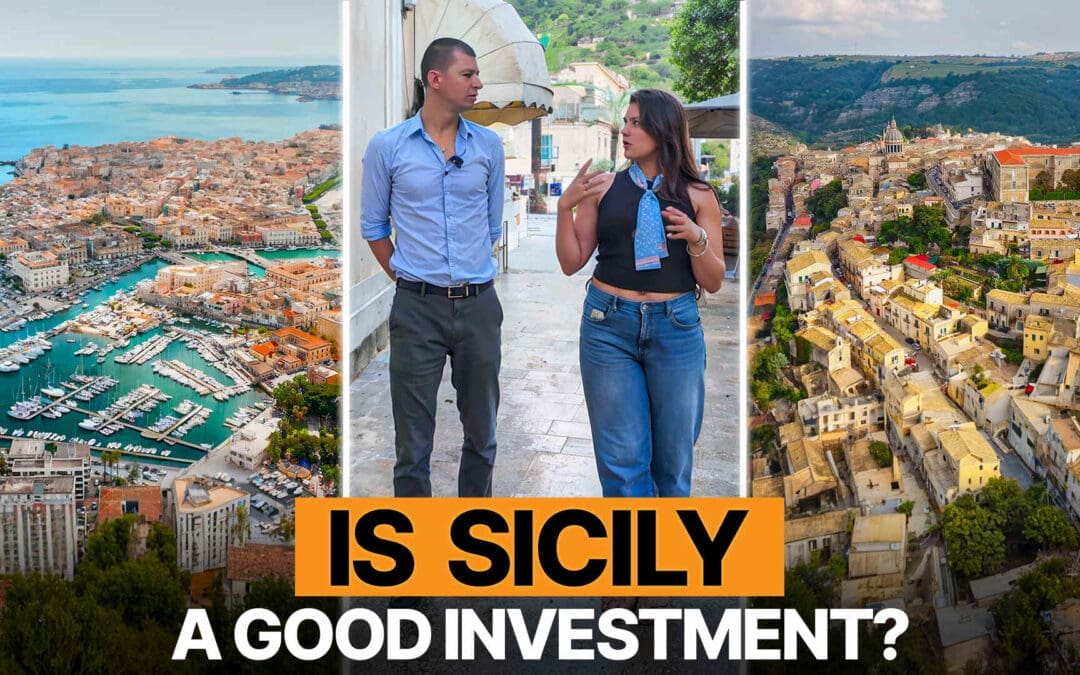
In this video, Shalise and I check out a few properties in the South East of Sicily, a region that is seeing higher than average growth in the region. Some properties are interesting, others less so.
Be careful with the 1€ home schemes
They were great marketing tools, but came with a lot of strings attached (you have to renovate within x amount of time, show invoices, in some cases move there, etc)
There is enough cheap property in Sicily that you can avoid bogging yourself down with an Italian government contract.
And manage your expectations
Southern Italy is lovely, but there’s a reason it’s poor. The culture is not particularly focused on productivity. It makes it an even more compelling case for lifestyle, but getting things done there is hard. This is why you’re better off hiring someone like Shalise to help you manage such a project.
Though she’s American/Canadian, she speaks Italian fluently and will get you proper quotes for renovations and will do the follow-up with contractors for you. In many cases you actually save money by using such a service rather than winging it on your own and dealing with Sicilian contractors that are your best friends one day and turn into ghosts a few weeks later. Feel free to get in touch with her for her Sicily and Malta buyer’s agent and renovations management services.
I’m writing this email from Chongqing, a hyper efficient Chinese megalopolis with an urban population of nearly 23 million.
The contrast couldn’t be any greater. I’ll take Sicily any day to relax.
To a World of Opportunities,
The Wandering Investor.
Services in Italy:
Articles on Italy:
- Why invest in Siracusa (Syracuse) real estate in Sicily? Good ROI
- Village life in Sicily – the case for real estate, taxes and lifestyle
- Renovating Historical Property in Sicily: is it worth it?
If you want to read more such articles on other real estate markets in the world, go to the bottom of my International Real Estate Services page.
Subscribe to the PRIVATE LIST below to not miss out on future investment posts, and follow me on Instagram, X, LinkedIn, Telegram, Youtube, Facebook, and Rumble.
My favourite brokerage to invest in international stocks is IB. To find out more about this low-fee option with access to plenty of markets, click here.
If you want to discuss your internationalization and diversification plans, book a consulting session or send me an email.
Transcript of “Renovating Historical Property in Sicily :is it worth it?”
LADISLAS MAURICE: Hello everyone, Ladislas Maurice of The Wandering Investor. Today we are in beautiful Sicily together with Shalise, who helps investors invest here in real estate in Sicily. And Shalise, you help people all over the island, but it’s really big. And when we’re talking, I said, “Look, let’s make a video on what you feel is the most interesting part in Sicily for investment purposes,” and you took me to this specific area here in Sicily. Can you talk a little bit about that?
Who should invest in Sicily real estate?
SHALISE: Yeah. Well, Sicily is really attractive for people because it’s quite cheap in general. But often, the towns are really cheap for a reason. So you can have no infrastructure, maybe no facilities, restaurants, bars. Either for people that want to just come and stay themselves into in these places or for tourism. So, instead, we have this area, it’s the southeast kind of corner of Sicily, which has a lot of growth right now because of things like a bit of increased infrastructure. There’s a Maltese businessman who’s bought essentially the entire Marina, which you see behind us here, and also has connected Malta to Ragusa with a new ferry line. So it’s made this southeast area a bit more attractive and a bit more interesting for investors. There’s also a new hotel that’s been being developed in this area, and there’s also a lot of Maltese people that have bought back and forth between here and Ragusa.
LADISLAS MAURICE: This is so random to hear about a region of the world growing because of Maltese investment. And here we’re talking of like actual Maltese people, right? Ethnic Maltese people.
SHALISE: Yes, yeah. Definitely, yes. Because Malta is really small and there’s not very much land, so everyone’s living in apartments and everything is getting built up. So, to escape and find some kind of farmland with a pool, usually they’re going for those kind of villa structures, they’re buying in this area basically between the Marina de Ragusa and Ragusa.
Sicily’s air connectivity to Italy, Europe and the USA
LADISLAS MAURICE: So, the you live between Malta and Sicily. How long is the ferry ride to Malta?
SHALISE: It’s about an hour and 45 minutes. So, it’s really convenient. They leave early in the morning so you have the full day in the marina when you come. And in this particular area of the Marina de Ragusa, and many of the kind of Marina or like coastal towns in the Southeast, you have a bit more of this 1970s, a bit newer construction. So it’s not quite that like historic center that many people are after, but we will see a bit later on some historic properties in these more beautiful villages that have a lot of baroque history and that even are listed in some UNESCO World Heritage sites as well.
LADISLAS MAURICE: And there are two airports around here.
SHALISE: Yes, you have Comiso airport, which is quite close. It’s around 30 minutes from here. It’s a bit more limited. You have a few flights going from Comiso to Rome and back, Lille, Brussels, a few areas like this. Um, and then you have another airport, which is Catania, which is a major airport. They have many international flights, even now New York to Catania, which just opened.
LADISLAS MAURICE: New York to Catania just opened. Oh, wow.
SHALISE: Yes. Mhm.
LADISLAS MAURICE: Actually, Sicily is a great base to travel around Europe because it’s got all the low-cost airlines that fly here and every day you have cheap flights to every single capital city pretty much in Europe. So it’s very, very well connected. Sicily is a good base for this. So, we’re going to see three different properties today.
SHALISE: Yeah, so we’re going to first take a look in Ragusa historic center. We’re going to take a look at an old ruin, which has beautiful views. It’s only 10,000 euros, so essentially it’s a symbolic figure. Uh, and then we will go see a larger palazzo with a lot of potential and finally an already restored palazzo, but let’s say with a bit particular taste.
LADISLAS MAURICE: All right. And then we’ll be doing approximate numbers for for all of those.
SHALISE: Perfect.
LADISLAS MAURICE: All right, fantastic. Let’s go.
SHALISE: Let’s go.
Lifestyle in Ragusa, Sicily
LADISLAS MAURICE: So, Vito, you’re the uh, you’re the culprit as to why Shalise speaks Italian, right?
VITO: Yeah, I mean, she already knew things before, but yeah, I helped her with the Italian, I say.
LADISLAS MAURICE: You guys have been together for a while and you’re originally from um, Northern Italy, but you come to Sicily on a regular basis.
VITO: Yeah, for holiday and yes, I was in Malta so we we spent some time here.
LADISLAS MAURICE: And I can confirm he he drives like an Italian. He’s he’s real.
So, Vito just parked the car. Remember how I was saying how Italian he is? Look at this. Well done.
VITO: Thanks. For lunch, pizza and more.
Why invest in Ragusa, Sicily? Case study with ROI figures
LADISLAS MAURICE: So, we’re about to see a 10,000 euro house right now.
SHALISE: Exactly, yes. And you can buy two for only 20,000.
LADISLAS MAURICE: So, tell us about the city here, Ragusa.
SHALISE: So, today we’re here in Ragusa on the way to Ibla. It’s a beautiful baroque historic town. It’s also on the UNESCO World Heritage list. And in terms of investing in Sicily, obviously Sicily is really attractive. You have a lot of people inquiring, but no one really knows from outside where exactly you should be investing in Sicily. There’s a lot of these one-euro house schemes that you end up in small towns without much access to anything, no public transit, no services, none of this kind of Italian lifestyle that people are really looking for with an investment in Sicily. Whereas something like Ragusa, you have a lot of infrastructure that’s being developed around. There’s a lot of external investment happening internationally. So they’re starting to build a community here and you’re finding those kind of prices like we were discussing for those kind of properties here. It also is a bit special because you have a river that runs just through the city. So, where the rest of Sicily can be very dry and arid through summer, through fall, here, as you see behind us, is always super lush and green all throughout the year. And the 10,000 euro house is right over there.
So, now we have behind us this house of 10,000 euros. It’s about 100 square meters inside, split across two levels. So you have an entrance from the road above us, which is a main road where you can park, really simple to find parking, really convenient to access the house, and another pedestrian only street where we’re standing right now with the fantastic church behind us. We’re looking at all in purchase, renovation, fees involved, around 180,000 euros. Uh, and revenues leading up to that would be around 5 to 6% after taxes, after property management and after some nominal maintenance costs.
LADISLAS MAURICE: And I think this is why it’s important to not get trapped by the the one euro houses, because when you come and invest in Sicily, your biggest investment is not the price of the house. I mean, we’re looking literally at 100 euros a square meter for this house. It’s the cost of renovations. And here, roughly, you’re I mean, it’s a really full, full gut job. I mean, it’s partially reconstruction. So, you put in the numbers 1,500 euros per square meter. But that’s for premium, premium renovation to really target higher-end clients who want locations like this, who want the view. As you were saying, the one-euro houses, they’re out in the sticks, in the middle of nowhere, there’s no liquidity, you make something nice, but then hard to sell, not really any demand for Airbnb. So again, it’s not the price of the house. It doesn’t actually matter whether this is 10,000, 5,000 or 20,000. Ultimately has almost no impact on your ROI. What matters in more is the renovation job.
SHALISE: Exactly. Your renovation, but also you need some key selling features, which are obviously the location needs to be important. Often the one-euro houses are located in areas where you don’t have any demand for rental, let alone to even reside there yourself, but also you need something that’s a bit unique. So here we have a fantastic view both over the historic city, but also over the valley where no one can ever build in front of you.
LADISLAS MAURICE: And we’re about a five-minute walk to some restaurants and a 20-minute walk to the core, core center. And it’s a pleasant walk too. It’s like walking in a cute historical town in Italy. It’s not like a punishment. You’re not, it’s not walking 20 minutes in in LA or something.
SHALISE: No, no, no. There’s proper sidewalks and everything is very beautiful. You’ll find many historic beautiful homes along your way. There’s many restaurants in Ragusa, both in Ibla and a bit further up on the hill. And uh, something that you can consider also is that there’s a number of houses behind us that are also in a a bit poor condition, where they’re not currently on the market, but something that we can also assist with would be to find the owners of those properties. If you wanted to buy this house and potentially the ones next to it as well.
LADISLAS MAURICE: Yeah, because you could buy a whole row and do something pretty cool. And essentially revamp the whole street, make it really cute if that’s the sort of thing you’re, the sort of project you’re, you’re into.
SHALISE: Exactly. And this is why it’s also so important to have someone on your team who knows about renovation and who can estimate these kind of projects from the beginning. So often agents will come and they will say, oh yeah, the property is 10,000 euros, but no one can give you really any kind of indication on how much something will cost or how much revenue it could potentially make. So it’s really easy to go south when you’re looking at these properties, especially if you’re not local. So that’s why it’s so important and what we try to keep in mind also from the very beginning with these kind of projects.
LADISLAS MAURICE: Look, I’ve spoken to a lot of agents here in Sicily and when you ask them, how much does it cost to do a renovation job? They’ll tell you, “Oh, 500 euros. Oh, 400 euros.” You maybe 10 years ago, kind of cheap Italian renovation job, which means that then you end up with a property that’s, it doesn’t own any space on the market, you’re middle the ground, you’re targeting lower budget clients, and that’s what a lot of people do here in in Sicily. They they invest here because it’s cheap, and then they also want to be cheap with the renovation, and then you end up with a cheap product. But actually the way to differentiate yourself and to make higher rental yields is not by going cheaper, because you’ll never do cheaper than the locals. It’s by going a bit more premium.
SHALISE: Exactly.
LADISLAS MAURICE: So now we’re going to Modica, right?
SHALISE: To go see some more high-end, more luxury properties, also divisible into multiple units, so it’ll be really interesting to take a look.
LADISLAS MAURICE: All right, fantastic. Let’s go.
Investing in a palazzo in Modica, Sicily: a case study
LADISLAS MAURICE: So we just got here to Modica. It was raining quite a lot actually.
SHALISE: Torrential.
LADISLAS MAURICE: Yeah, so it’s hard to capture. It’s a little dark inside the apartment, but gosh, this building is beautiful. What’s the what’s the history?
SHALISE: So this is a an 18th century palazzo that’s been divided. We’re here on the Piano Nobile, so it’s like the most prestigious floor. Uh, and this particular apartment has 200 square meters. And interior you’ll find some beautiful frescoes, old wallpapers and it’s a bit partially restored. It’s an inherited property, but the owner wants to redo it properly and basically doesn’t have the funds so is looking for someone else to take it over.
LADISLAS MAURICE: What’s the price?
SHALISE: The asking price is 450,000. And then in total after renovation, closing costs, design fees, uh architect fees, you’re more likely looking at a total budget including purchase around 700,000. But in the end you would be able to transform it into some kind of boutique B&B property with a minimum of five suites, you could potentially do more, but at least it would be relatively luxurious. You could do at least five, and then you would be making around 60,000 per year. Let’s say, uh after paying the management, but before taxes.
LADISLAS MAURICE: So the previous house you had estimated about 1,500 euros per square meter for the renovation/building. Here you’re estimating how much?
SHALISE: About 900. You have also beautiful garden outside and so you would also want to enhance that with some landscaping perhaps. Overall your floors are in quite good shape, but I would say new electricity, new plumbing. You have a lot of bathrooms to do and a lot of furniture to move as well if you really want to create a high-end luxury kind of rental, which I think it this property in particular really lends itself to.
LADISLAS MAURICE: Yeah, this building is structurally sound as opposed to the other one. We peeked inside the other one, just peeking inside was a bit dangerous. And there, what’s interesting with this one is there are two entrances, right? One lower street and one the street above.
SHALISE: Three, in fact, yes.
LADISLAS MAURICE: Three.
SHALISE: Yes. So you could if you even wanted to create three apartments, that would be a bit larger, you could easily do that as well. One from the garden, one from the street above and one from where we entered downstairs in the common area.
So you can see we’re standing here on this beautiful baroque balcony, but this property has a lot of gorgeous historic features. One of them is the amazing kitchen at the back that we’ll show you in a bit and it’s has an old stove with all done with tile that leads into a small courtyard, but just over here, I can show you a small secret that shows a bit of the history of this building. So in this corner, you can see, ignoring the bottle, not part of the history, but here you have a really thick wall. So already this wall itself is around 1 meter thick. And the angle of the window that you see here is intended to be able to essentially shoot arrows at invading people who come.
So before we go into the next property, it’s really important to also understand that this is a common block. So obviously, behind us, we have the beautiful entrance that leads us into the apartment. You have this incredible historic courtyard and staircase that are also part of the charm, but obviously, they also have upkeep. And it’s important to also understand whether the other apartments are also willing to keep up with these kind of maintenance of this type of building, and if there have water entry or leaks, for example, into their apartment, which could affect yours, do they have the cash to essentially be able to fix those kind of things? Or are you going to be the only one trying to maintain this by yourself? So, part of what we do is that we’re also able to speak with the other owners as well to see if they’re really able to continue the maintenance of the property with you or if they’re only going to be able to do a bit of maintenance here and there and the rest of the responsibility will be on you.
LADISLAS MAURICE: Are you out of breath after these stairs?
SHALISE: Yes, exactly.
LADISLAS MAURICE: No elevators here.
Renovated apartment in Modica, Sicily: lifestyle opportunity
SHALISE: No. We’re on the main road now of Modica. Uh, this is the one of the main piazzas just behind us and we’re on our way to a historic Palazzo. It’s actually an apartment that’s been turned into a palazzo or on the piano nobile of an apartment of a palazzo. And we’re going here. It’s about 990,000, but it’s 400 square meters inside, so it’s quite big. It’s been already renovated. Obviously that’s hence the price, but it is renovated, let’s say in a bit particular style. So it can be also a case to show why you can put your own work into a property that can get you perhaps a bit more equity and also so that you’ll be able to transform it into what you want rather than buying something at a premium that’s already been renovated.
LADISLAS MAURICE: And who’s who’s buying in Sicily these days? Who’s buying these apartments in these palazzos?
SHALISE: Right now, the market is starting to grow also with Americans, which is quite interesting. It’s a very recent trend. Previously you had a lot of French people who were buying, perhaps Italians from other regions, but also a lot of Germans. And personally I have also a lot of Canadian and Australian clients, which makes it quite interesting.
LADISLAS MAURICE: Interesting. And you were saying a bit earlier, a lot of Maltese now investing in these areas.
SHALISE: Also, yes, this is a more recent trend as well, particularly in this Modica Ragusa area.
LADISLAS MAURICE: All right. And this is the entrance to the to the place.
SHALISE: Exactly. So they told us also that this building was originally divided about 100 years ago, and when it was the marriage of the owner’s relatives, previous ancestors, let’s say.
LADISLAS MAURICE: Nice high ceilings, right?
SHALISE: Mhm. You have a lot of character here. It’s another 18th century building, a little bit newer from a more neoclassical period. You have original floors, you have some maiolica, some cement and this is a local Ragusan stone made from petrol. But then as you see, we had some renovations that were perhaps a bit not well thought out, unfortunately. And so you have some issues like that typically when you find already renovated properties. It’s very rare to find something that’s going to be renovated how you intend to use it. At 400 square meters, the property could have easily been divided into at least four units that would have been quite comfortable, but to have to renovate it again when you’re already paying a premium for equity, it doesn’t make much sense. Even if it’s something so beautiful where you have all of these frescoes that have been beautifully preserved throughout. It’s been unfortunate.
LADISLAS MAURICE: Yeah, it’s just so unacceptable to have an air conditioning in here when you have such beautiful vaulted ceilings.
SHALISE: Stunning.
LADISLAS MAURICE: Yeah, either you buy unrenovated and you do it yourself or you buy renovated, but often it’s especially in this part of the world. I’ll put it this way. If you go to Scandinavia and you buy renovated, generally speaking, you’re fine. Uh when you come to Southern Europe and you buy renovated, there’s usually something that’s off for us non-Southern Europeans.
SHALISE: But I think it’s also important to think about if you want to do a combination investment and lifestyle, so you want to also spend some time here, but also rent it out. It’s a very particular case. This one lends itself more to a single family home already. So if you really want to invest again into it, it’s a bit of a hassle.
LADISLAS MAURICE: So you wouldn’t recommend this one as a pure investment?
SHALISE: Not as a pure investment. If you really want it, it’s really beautiful. They’ve done a nice job. A fun fact was that the agent told us that when he was originally coming here to stage the property, he called it the House of Dolls and that he found about 150 dolls throughout the whole house. So I think it gives you a bit of indication of what the type of renovation that was done here, but overall, a lot of the furniture is included. If you like this kind of more antique items, but as an investment, I think it’s a bit of a difficult proposal.
LADISLAS MAURICE: For sure. And some of the bedrooms have these frescoes as well. Yeah, interesting.
Don’t make these mistakes when investing in Sicily real estate
LADISLAS MAURICE: So, to recap, the southeast of Sicily is where you recommend people invest here because of the airports, because of the historical cities, uh generally speaking, it’s pretty well connected. There’s new infrastructure development, but it’s a complex market.
SHALISE: Mhm. Sicily in general is quite complex and often people write me that they want to buy in Sicily, they don’t really know where they want to be. Obviously everyone’s part of one euro house schemes, but these are not really so feasible for anyone who wants to invest or also just to live here themselves or whatever mix of both. So I think the Southeast is a really nice case. You have actually a lot of development happening both in real estate and also a bit of infrastructure as well. So it lends itself a bit more to a growing market versus somewhere that maybe Palermo or Catania that’s already established, and also it’s a really beautiful lifestyle choice. So, not only do you have a lot of tourism that’s already existing, also growing, but even more that you have a really beautiful lifestyle if you want to experience that kind of Dolce Vita Italian life here.
LADISLAS MAURICE: So, I I see all the pros, I see the lifestyle, I see why it’s attractive, I see decent rental yields in in some cases like the the first one, that was a that was a winner for sure. But it’s just complicated. It is just so easy to make an expensive mistake when you buy in Sicily. So this is really the sort of market where you want expertise to help and guide you through the process.
SHALISE: Yes, certainly. And it’s something that we consider from the very beginning. It’s not only what, how much money you have to buy the property, but also estimating renovation costs and helping to estimate any kind of revenues as well. So you have a really comprehensive view of the project from the beginning and obviously you don’t end up in some kind of money pit.
LADISLAS MAURICE: And you, Shalise, your background is you studied fine art at the American University of Paris. You speak Italian and you’ve been doing renovation jobs and acting as a buyer’s agent here in Sicily and in Malta for quite a few years, right?
SHALISE: Yes, for at least seven years, and I was also buying, renovating and renting property on Airbnb, as well as flipping myself. So, I’m an investor myself, so I’m really familiar with all the things that you need to keep in mind when you’re looking at renting or selling a property.
LADISLAS MAURICE: All right, so Shalise is our girl. If you are interested in Sicily property, feel free to get in touch with her. There’s a link below. Shalise, thank you.
SHALISE: Thank you.
LADISLAS MAURICE: Make sure to download my free e-book, 12 Mistakes to Avoid When Investing in International Real Estate, which you can find on my website, link below, and feel free to follow me on Instagram @thewanderinginvestor. I look forward to hearing from you.