I keep seeing videos and articles claiming that foreigners cannot own land in Cambodia, and that this is a good reason to buy Cambodian citizenship.
While some of them may be outright lying, many of these people are simply misinformed and don’t actually spend time on the ground, instead taking random online articles and ChatGPT at their word.
I’m on the ground as we speak. I’m spending two months in Cambodia with my family, working on a number of opportunities.
And yes, I bought land in early 2025 in Cambodia. Am I a Cambodian citizen? No.
Did I use a dodgy structure like a nominee agreement, or a company with a 51% local partner like many people do here? Or as many investors are forced to do in Thailand? Absolutely not.
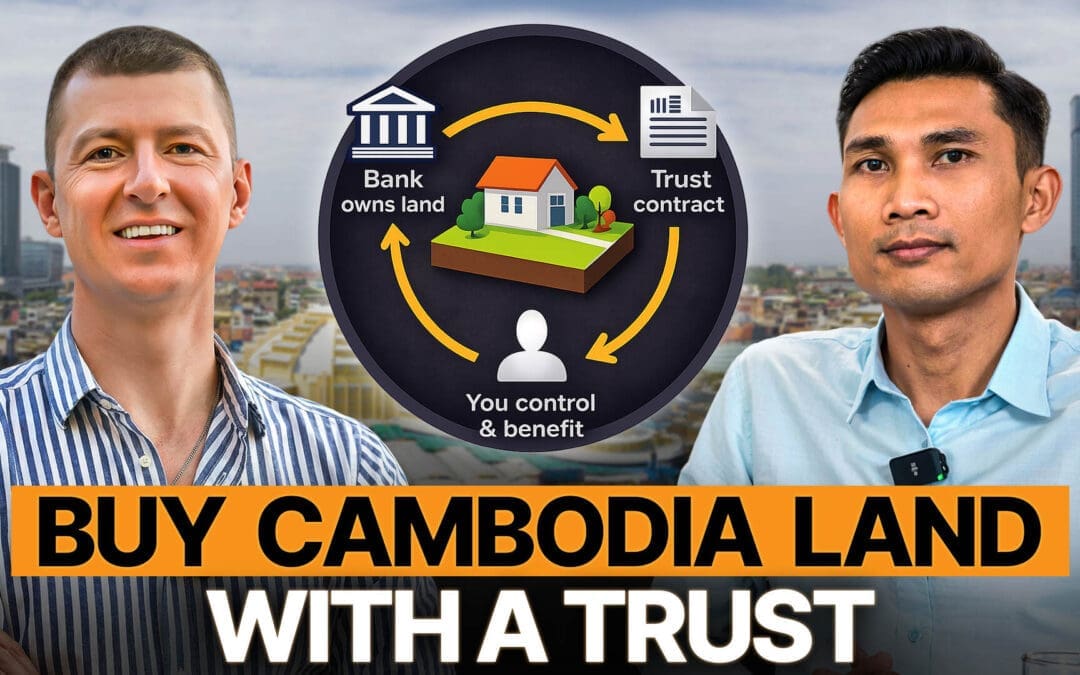
I used a trust. There is a trust framework in Cambodia, based on Australian law. Clean.
This means your trustee can buy any landed house or land in Cambodia and you retain full, legal control. This is unique in South East Asia.
Cambodia is very welcoming of foreign investment.
In this video with my realtor Untac, we discuss the different types of title deeds and forms of ownership in Cambodia.
I am increasing my allocation to Cambodia.
Is there risk? Sure, there was a border dispute with Thailand just a few weeks ago. Size your positions accordingly.
Feel free to read the Phnom Penh Real Estate Investor Guide. You won’t find a better resource elsewhere.
My Phnom Penh realtor Untac can help you with everything on the ground.
To a World of Opportunities,
The Wandering Investor.
Services in Cambodia:
Articles on Cambodia:
- Phnom Penh Real Estate Market: 2026 Investor Guide – Boom or Bust?
- Siem Reap Real Estate Market: Investor Guide
- Phnom Penh Real Estate in Cambodia ROI Breakdown & Rental Yield Case Studies
- Opportunity after the Bust? Real estate in Sihanoukville, Cambodia
- Foreigners Can Own Land and Houses in Cambodia: How to structure your Cambodia real estate purchase
If you want to read more such articles on other real estate markets in the world, go to the bottom of my International Real Estate Services page.
Subscribe to the PRIVATE LIST below to not miss out on future investment posts, and follow me on Instagram, X, LinkedIn, Telegram, Youtube, Facebook, and Rumble.
My favourite brokerage to invest in international stocks is IB. To find out more about this low-fee option with access to plenty of markets, click here.
If you want to discuss your internationalization and diversification plans, book a consulting session or send me an email.
Transcript of “Foreigners Can Own Land and Houses in Cambodia: How to structure your Cambodia real estate purchase”
LADISLAS MAURICE: Hello everyone, Ladislas Maurice of The Wandering Investor. So today we’ll be discussing how to own real estate in Cambodia because there’s just so much misinformation online. A lot of people come to Cambodia, they invest in real estate, they make mistakes with their legal structures and end up losing everything. So it doesn’t have to be this way. It’s actually really safe to buy in Cambodia if you use the right structures, if you know what you’re doing.
Invest in real estate in Cambodia : forms of property ownership and titles
LADISLAS MAURICE: So here, Untac is a realtor who is based in Phnom Penh and covers both Phnom Penh and Siem Reap and you’ve helped a number of foreign investors make investments here in Cambodia. So you’ll explain to us the various structures and the various types of titles as well than what can find in the market.
Strata title : the most common form of ownership for foreigners in Cambodia
UNTAC: If you look into Cambodia market, the most common term that you might hear, it’s Strata title. So this are basically for foreigner who can own outright and it’s quite easy, nothing complicated. This are we talking about a foreigner can own anything from the first floor up, not in ground floor. This are the most common one that you might heard of when we deal with, but then we have a lot more uh title that I’m going to go through the detail.
Hard title : safest form of ownership for foreigners in Cambodia
UNTAC: The first one is hard title. So hard title is the most secure, it’s the safest title that you can own. Potentially it’s register by the national level. So once you have the hard title, that’s it.
Soft title : partial and unsafe property rights for foreigners in Cambodia
UNTAC: There’s no one else can claim that that theirs a lot of the cases for the other title, which is the soft title, that only recognize in regionally. We have some of the case that people come up with two people having the same soft title, but when you’re trying to register your soft title to a hard title, which is you need to go through a national level, they say, oh actually, that’s not the only title you have. There’s another one having a similar title and that case it goes through a refute, and that could be very complicated. Some investors, some foreigner do fall into this issue.
LADISLAS MAURICE: Yeah. If you buy soft title and there is this, I mean it’ll be years of court cases and then use the foreigner or like clearer to not to to lose the battle, I’m generally speaking. So, yeah, so essentially strata title completely safe. Hard title completely safe. They’re actually the same. Strata is just a category of hard title. The difference being that hard title can apply to anything, land, homes. You can’t own in your own name as a foreigner.
UNTAC: Yeah.
50-year leasehold real estate in Cambodia
LADISLAS MAURICE: So, and then there’s leaseholds as well, right?
UNTAC: Yeah. 50 year lease hold.
UNTAC: Yeah, before the government used to have the 99 year lease hold, but now we cut it down to 50 year lease hold, which some project does do that, buying a 50 year lease hold and then sell it within this time frame.
LADISLAS MAURICE: Yeah, so you got to be a bit more careful with those. It’s a bit like Bali. I’d be a bit wary of getting involved in in lease holds, especially in a market where you don’t have to.
LADISLAS MAURICE: Okay, so strata, I can come just with my passport, even remotely, boom, by my name is on the title deed. It’s clean.
UNTAC: Easiest, most straightforward.
LADISLAS MAURICE: Cool. Now let’s say I want to buy a house, I want to buy land, I’m not touching lease holds personally. Soft titles, it’s a gamble. It’s fine. It’s a gamble. Um hard titles clean.
UNTAC: Yeah.
Buy real estate in Cambodia with a Cambodian nominee
LADISLAS MAURICE: So, let’s say you help me choose, for example, we’re in Siem Reap, there’s a house I like, a piece of land, I want to buy it, I can’t buy it in my own name. What are the different structures that exist in Cambodia for a foreigner like myself to be able to buy land?
UNTAC: Yeah. So the normal traditional way that you might heard of or you might seen a lot, the same here in Bali is people do it through nominee. But personally, I’m not recommended. So a nominee basically, you find some local that you trust, could be your partner, could be your friends, and then you basically having their name to own that property that you want to own, and you create a legal framework around it, but at the end of the day, if that come to the national court or the court, they will overrule because the state law or the conditional law, it’s above the agreement between both party. So that’s strongly not recommended.
Buy a house or land in Cambodia through company creation and shared ownership
UNTAC: The second way that you can do it, it’s through creating a company and we see this happen quite a lot where a foreigner or investor will create a company that they own 49% and the Cambodian own 51% and they the same thing with nominee, they creating a legal framework where they are the one who drive the decision making and and stuff. There’s a little more complicated in terms of paperworks and how to get it done, and the other one is through trust.
LADISLAS MAURICE: I think before going to the trust with the company, essentially you’re stripping the Cambodian partner of most of their rights, economic rights, decision making rights, etc. So it’s it’s a lot cleaner than just the nominee because the actual owner is still a Cambodian entity and the agreement within a company is stronger than just a random agreement on the side with a with an individual.
UNTAC: Yeah.
LADISLAS MAURICE: But now there’s a much better framework, right?
Buy property in Cambodia using a property trust : cheap, efficient and flexible structure
UNTAC: Yeah. There’s a new things called trust or trustee. Uh now this come on the market quite recently and a lot of people don’t know enough about it. Most people, most agent, most agency will just say no, it’s too expensive or no because they don’t know enough about it. This is something very exciting that we we could potentially discuss about.
LADISLAS MAURICE: Yeah, so it’s mostly based on Australian trust law, so essentially you can be the one that controls the trust, you put the trust in the name of a bank or a law firm here in uh here in Cambodia, and then you can designate yourself or anyone else as the the beneficiary that you retain control or a company that you control or whatever or a foreign entity or a foreign trust or a foreign foundation. So it’s very flexible. It’s good for succession planning as well. And they’re not that expensive. Um you’re looking to set up costs less than $1,000. You know, you’ll have a few fees during the during transactions. You know, the bank or the law firm will have to do a bit of due diligence, etc. But then the yearly fees are between, you know, I’ve seen anything ranging from $1,000 a year to, you know, 1 to 1.2% of uh assets under management.
UNTAC: Yeah.
LADISLAS MAURICE: So it’s very reasonable and the legal framework for this is really strong.
UNTAC: Yeah. If you look on the market, if you uh search, a lot of people probably have a fall information regarding people say it’s expensive, way too expensive, but actually if you really dig deeper, if you know about it, actually it’s not, it’s not as expensive at all.
LADISLAS MAURICE: It’s not more expensive than a company. Yeah. It’s a lot more secure. Uh but the thing is because the market is not familiar with trusts here, so it’s a new concept, just like a lot of European countries don’t know how trusts operate and work because Europeans, a lot of European countries don’t have this in their legal framework. People just are scared of it, they say, no, it’s not good. A lot of real estate agents have never even heard of it, even foreign uh real estate companies that are owned by foreigners.
UNTAC: Yeah.
Investing in condos, houses and land in Cambodia : choosing the right structure
LADISLAS MAURICE: They still going around showing, you know, their best friend who can be a nominee and whatever company, it’s just uh so I’m personally looking at making investments in in Cambodia, you’ve introduced me to a good um company that deals with all these trusts. Yeah. And if and when I decide to to buy here, I’ll just I’ll just use them. It can be done all remotely. Yeah. They can open the bank account remotely, everything. It’s a few weeks of paperwork, nothing too heavy, and then you’re just good to go and you can just invest in whatever you want in in Cambodia. So, yeah.
UNTAC: Yeah.
LADISLAS MAURICE: Yeah, thanks a lot for introducing me to to these people because that really changes um the the range of investment opportunities that you as a foreigner have in Cambodia, as opposed to just condos, and some of them are fine, nothing wrong with condos. Now you can really go, there’s a lot you can invest in in in Cambodia. So, that’s pretty exciting. It’s a huge development in the country that really is not being discussed at all.
Contact Untac and learn more about Phnom Penh and Siem Reap real estate market
UNTAC: If you have any question about trust company or want me to introduce the trust company, please feel free to reach out to me.
LADISLAS MAURICE: Also, I wrote a whole article on the real estate market here in Phnom Penh, the areas to look at, the areas to avoid, all the infrastructure development that’s happening in the cities, the bridges, the airport, etc, where all of this is happening. Uh there’s a link below and I did the same thing as well for Siem Reap analyze that market. We have case studies, etc. There’s a link below as well and then you can get in touch with Untac, thank you very much.
UNTAC: Thank you so much, Ladislas.
LADISLAS MAURICE: Make sure to download my free ebook, 12 mistakes to avoid when investing in international real estate, which you can find on my website link below, and feel free to follow me on Instagram @thewanderinginvestor. I look forward to hearing from you.