Africa is the future
You may or may not like this statement, but the reality is that booming demographics in Africa, combined with collapsing demographics in much of the world, will ensure that Africa’s global importance keeps growing.
It’s something I understand personally. I spent most of my twenties in Africa. In my last role I sat on the executive board of Nestlé Ghana, charged with overseeing the dairy business in a few West African countries.
Now imagine how great a gift it would be to secure full access to the ECOWAS economic bloc, the European Union of West Africa?
With the passport of Sierra Leone, you, your family, and your descendants will have preferential access to 12 countries in one of the world’s fastest growing regions.
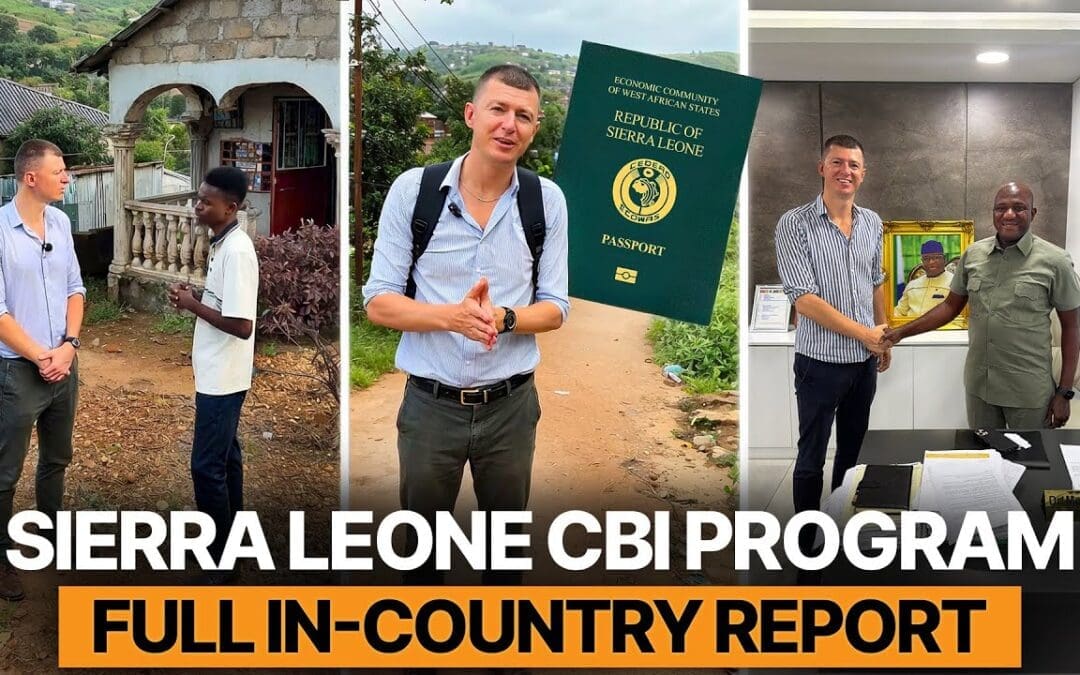
Along with my team, I went down to Sierra Leone for two weeks to do firsthand due diligence on the citizenship by investment program the country launched last year. We met with government ministers, business people, religious leaders, local youth and other stakeholders.
This is a full-on documentary on the Sierra Leone Citizenship by Investment program.
I get criticized all the time for promoting African Citizenships by Investment
People take one look at the limited visa-free travel options to developed countries, and the low GDP per capita of these countries and then rush to the conclusion that these passports are worthless.
I disagree. I see a long term, generational move.
Full access to Ghana, Nigeria, Ivory Coast and Senegal represents big utility. You can go there visa-free and even settle there very easily.
And for the “Plan B” crowd, I can tell you that some places in West Africa such as in Ghana, Ivory Coast and Senegal are genuinely enjoyable and fun, hosting huge expat communities. Not to mention, they much more accessible to Europeans and North Americans than Vanuatu or Nauru.
A great deal in Sierra Leone
The Sierra Leone Citizenship by Investment program is very flexible:
- Easy documentation
- Can be paid in crypto
- A broad range of dependent family members can be added, both immediate and extended.
- You can add an unrelated business partner for $30,000. This is an amazing deal, imagine splitting the cost with him/her. It makes it the most affordable CBI in the world for two unrelated adults.
- Applicants of African descent receive a substantial Heritage discount that makes the donation only $100,000 for an individual.
- Change of name is possible for an extra fee
We at The Wandering Investor are licensed agents for this program. As with the Sao Tome CBI we do not add additional agent fees, unlike most of our competitors.
Feel free tor each out to us for more information or a free call to discuss your Sierra Leone Citizenship by Investment application.
To a World of Opportunities,
The Wandering Investor.
Services in Sierra Leone:
Articles on Sierra Leone:
- Sierra Leone Citizenship by Investment – a conversation with the program architect
- Sierra Leone Citizenship by Investment program – Who should apply?
- On the Ground Diligence for the Sierra Leone Citizenship by Investment
Subscribe to the PRIVATE LIST below to not miss out on future investment posts, and follow me on Instagram, X, LinkedIn, Telegram, Youtube, Facebook, and Rumble.
My favourite brokerage to invest in international stocks is IB. To find out more about this low-fee option with access to plenty of markets, click here.
If you want to discuss your internationalization and diversification plans, book a consulting session or send me an email.
Transcript of “On the Ground Diligence for the Sierra Leone Citizenship by Investment – Weeklong Government Tour”
LADISLAS MAURICE: Hello everyone, Ladislas Maurice from The Wandering Investor. Today I’m at Istanbul airport and I am on my way to Freetown in Sierra Leone. Why? Because we’re licensed agents for the Sierra Leone citizenship by investment program and we’ve been invited by the program administrators to join a delegation in which we’ll meet senior government officials and they want to show us the country so that we get a better understanding of what the opportunity is. We’ll also be meeting with a few of our clients that are flying from different parts of the world who are considering the program for themselves. So the event is supposed to last four days, we’ll be staying a full eight days in Sierra Leone because we want to spend more time on the ground to look at investment opportunities as well and to really get a feel for the country. So let’s go.
African American tourism in Burkina Faso
LADISLAS MAURICE: So the plane almost emptied out here in Ouagadougou, which I was not expecting because most people were speaking English. All the African Americans got off here in Burkina Faso, which is surprising because it’s a Francophone country. I was expecting them to go to Sierra Leone because many of them go to Sierra Leone and Liberia specifically. But what’s transpiring is that thanks to the administration of Ibrahim Traore here in Burkina Faso, there’s a renewed interest in Pan-Africanism and a lot of these African Americans are coming here to experience it firsthand. So I was not expecting this. Insightful.
New airport in Freetown, Sierra Leone
AIRPORT STAFF: Welcome to Freetown. Thank you very much, I appreciate it.
LADISLAS MAURICE: Honorable Kassegbama, who is hosting us. How are you?
HON. KASSEGBAMA: I’m fine. And you? Welcome to Sierra Leone. This airport was finished two years back. It was built by the Turkish people, a company called Summa, in collaboration with the government of Sierra Leone.
LADISLAS MAURICE: Is there a lot of Turkish investment in Sierra Leone?
HON. KASSEGBAMA: Not really. They are here, but not that much, but they collaborated with the government of Sierra Leone to get this one done for us.
LADISLAS MAURICE: So it’s something that we see a lot in Africa increasingly is Turkish investment, and the way Turks enter the market is always through infrastructure development. And now we’re going to take the ferry to town.
HON. KASSEGBAMA: Yes, it’s not really the ferry. We are taking the boat called Sea Coach. The ferry is on the other side, and we have private companies. We have the Sea Bird, we have the Sea Coach. They have flexible boats. It’s more comfortable than the ferry. The airport is far from the city if you don’t cut through with a boat. It’s a 35 to 40 minute ride across the sea to the city. The government is planning, because our prayer is for us to have the bridge to make it easier for people that come in to just move to Freetown easily.
LADISLAS MAURICE: I bet the boat companies are probably not happy about that.
HON. KASSEGBAMA: I know. That one is the worst. They’ll not be happy about that. But that’s our prayer. As you are here, we’ll just drive direct to Freetown.
LADISLAS MAURICE: Hey, breakfast time. It’s a Sunday morning. I managed to get an extra sandwich out of Turkish Airlines last night, and the Airbnb host left water. So this is how people drink water typically in West Africa in these little plastic pouches. It is a Sunday morning, so we are going to go to church and praise our Lord.
DRIVER: It’s Sunday, no traffic.
Going to church in Sierra Leone
LADISLAS MAURICE: A lot of traffic during the week? Oh yeah. This was a lovely mass at St. Anthony’s Catholic Church and now we are a little hungry. We’re going to try to find some grub, find a restaurant or something. And then we’re going to meet with Stephen, the program architect, to talk about the week ahead. We’re in the parking lot of a nice hotel here in Freetown and look at that, only Toyotas. This is the ultimate status symbol in much of Africa.
DRIVER: Actually, we Sierra Leoneans, we love white people. Most people are coming from America, France. They’re welcome to Freetown, Sierra Leone. Freetown, Sierra Leone is a safe spot. No money and all this. Welcome back to Freetown.
LOCAL RESIDENT 1: This is Macavelli from the Black Streets Family. I’ve been in this game for a decade. Rap is my trade. I’ve got no time for no fake soldiers, real soldiers. You know I step on the street, I’ve got my own gang, my own speed. My name is Dog Grizzy, sponsored by Way Out Family worldwide. www.wayout.com for life.
LADISLAS MAURICE: Today is a lovely Monday morning in Freetown. So yesterday was quite good. We met with Stephen, we drove around town and shot some B-roll of the city because there isn’t much traffic on Sundays unlike days of the week that can often be quite hectic. But today we have a really interesting program. We’re going to meet with the Chief Immigration Officer and then we’re going to meet with the management teams of two different banks to understand their outlook and their operations here in the country. And the day will finish off with a nice welcome dinner for all the delegates that came through from all over the world.
Start of Sierra Leone Go-For-Gold Delegation
LADISLAS MAURICE: Alright, so we’re at the Immigration Department here in Freetown. We’re going to go meet the Chief Immigration Officer. A lot of the money being donated will initially be used to revamp the whole building because right now it’s kind of derelict. And that’s why countries like Sierra Leone are doing this. It’s not only to attract people who will invest more money into the economy and attract new citizens with means, but also to take these donations and revamp government buildings and invest in infrastructure in the country.
Chief Immigration Officer of Sierra Leone
STEPHEN: We’re very grateful for your time and for receiving us and also for facilitating the introductions to your colleagues in government.
DR. MOSES TIFFA BAIO: Thank you very much, Mark. And again, let me welcome all of you. We hope you enjoy your stay. We’ll do our best to create the enabling environment for you to have a very good memory of Freetown. We also welcome you, this is the office of the Immigration Department. It’s a very exciting opportunity actually to have you on board this program as well.
The President, like I said, wants to reform, and one of the areas he wants to reform is immigration. And why does he want to do that? He wants to open up the economy, he wants to open up the country. We are a very peaceful country, we have democratic stability, we have changed presidents three times peacefully through democratic means.
Everything that you have to do in terms of investment, they would do everything for you. They’ll also provide aftercare services. It’s not only encouraging you to come and invest and they leave you, they’ll also be with you throughout your investment journey. Make sure that they provide you with all the social safety nets required to ensure that your investment succeeds. Because whatever penny you put into the eye, you employ more Sierra Leoneans, you pay your taxes, it generates more revenue to government. So the longer we’re able to sustain that over time, the more people you employ, the more taxes you continue to pay, the more revenue. So the multiplier effect on the economy is far greater. So having all that in mind, that’s where we are trying to put a very competitive package together. And as we say in our local language, ‘una kushe and kabo’. Thank you.
Stephen Barnes, Sierra Leone CBI Program Director
LADISLAS MAURICE: So we’re here with Stephen, who is the program architect here of the Sierra Leone citizenship by investment program. Stephen, how are you?
STEPHEN: I’m good, I’m good.
LADISLAS MAURICE: So today you took us to meet the Chief Immigration Officer, so this was really interesting. And now we have two banks that are coming to present, correct?
STEPHEN: Yeah, Ecobank and UBA bank. They’re coming to basically pitch everyone for their money.
LADISLAS MAURICE: Increasingly in the world when you go to banks, they don’t necessarily want to deal with you, but here they’re hungry for capital. Ecobank is a Pan-African bank, it’s actually very well-respected. And UBA is originally from Nigeria,
STEPHEN: I believe so, yeah.
LADISLAS MAURICE: And then when you become a citizen, you help applicants or new citizens rather open accounts?
STEPHEN: Correct, yeah. So the idea is that because of the robust due diligence that all participants in the Go for Gold program go through, the notion of the banks is if it’s good enough for the government, it’s good enough for them. So that’s enough KYC for them to open the accounts.
LADISLAS MAURICE: And what’s particularly interesting about Sierra Leone as a banking destination, and look, we’re not saying, I’m not here saying that this is an offshore hub and this and that, let’s be realistic here. Sierra Leone banking is very privacy-focused, it has not signed up for CRS, which means that the authorities will not automatically share your banking information with your other countries or country of tax residency.
STEPHEN: I think one other point to make is that, you know, rightly or wrongly, Sierra Leone is a cash economy. All the businesses pitch up at the bank every Friday afternoon with their sacks full of cash representing the week’s takings. The banks are not afraid of cash. That’s not to say that you can pitch up with a million dollars in a suitcase and expect to get it banked without any questions. It just means that there’s a certain efficiency to banking in Sierra Leone that you don’t see in OECD jurisdictions.
LADISLAS MAURICE: Are there any capital controls or foreign exchange restrictions?
STEPHEN: No, none whatsoever.
LADISLAS MAURICE: So if I have let’s say $100,000 on my bank account here and I want to wire it to my account in the US?
STEPHEN: Internet banking, give the instructions, it’ll get done.
LADISLAS MAURICE: And there’s no central bank queue like in other African countries?
STEPHEN: No, because they’re such an exporter of natural resources including gold and foreign exchange reserves are not an issue.
LADISLAS MAURICE: Alright, interesting. Let’s go.
Meeting with Ecobank and UBA
BANK REPRESENTATIVE 1: There is what we call offshore charges. That is $35, it is fixed irrespective of the amount. For us at the bank, of course, we are a profit-making entity. We always charge 1% off the total sum, which is negotiable based on volume. And then of course, of late, government has levied GST on every income that we make as a bank. So 15% off that 1%. Those are just the charges: 1% commission, $35 offshore, and then 15% government GST. That’s just it.
BANK REPRESENTATIVE 2: You can do your payment to anybody you have to pay, you can do your payment on the online platform. You can do your conversion, say you want to convert from USD to our local Leones, you do it on the platform. We also have the internet banking for individual accounts, say for your personal account. You can be here and transfer money back home without going to the bank. You can do your conversions online.
And when we come to our cards, we have our Visa cards. You can use our cards internationally and locally. Ecobankis everywhere. When it comes to internet banking, we have been crowned as the best bank. We will be happy to be part of your team. In terms of customer service, we probably say we are the best bank. You don’t want to have your money somewhere when you want to access it you find difficulties in getting it. Customer service we will give, it’s a top-notch for Eco Bank.
LADISLAS MAURICE: Alright, so now we have to rush. We’re going to meet the Speaker of Parliament. We’re going to go to Parliament. But what we learned from these banking meetings is that actually there are some capital controls, soft capital controls, but only for individuals. So if you’re an individual transferring more than $10,000, it will elicit a lot of questions and potential limits. But if you have a local entity, then there are absolutely no capital controls nor foreign exchange restrictions. Alright, let’s go.
Meeting with the Speaker of Parliament of Sierra Leone
LADISLAS MAURICE: So we just had a last minute rush from the hotel to Parliament, Stephen, why?
STEPHEN: Well, because our colleague has been able to arrange an audience on short notice for us to meet the Speaker.
LADISLAS MAURICE: The Speaker of Parliament.
STEPHEN: Correct, yeah.
LADISLAS MAURICE: Alright, fantastic. So, we’re lucky we’re going to be going into the actual parliament?
STEPHEN: I believe that will be the case and then we will have an audience with him and we will be able to understand more about the democratic process and the democratic tradition in Sierra Leone.
LADISLAS MAURICE: Exciting.
HON. SENGEPOH SOLOMON THOMAS: You are all welcome to the House of Parliament. This is the people’s house. As I can see, you have already started enjoying the niceties of Sierra Leone also. Thank you very much for coming.
STEPHEN: Thank you, Honorable Speaker, for your time and your attention. I know you’re extremely busy. I’m pleased to introduce our delegation that have come from a number of different countries from France, we have from the United States, from Germany, from India. And we’re here in pursuit of the Go for Gold program, which creates the conditions for foreign direct investment. We have participants in the program that come from a variety of different sectors. We have a medical doctor and a professor, we have software developers, we have a sixth-generation publisher. There’s quite a considerable collection and depth of entrepreneurial experience and endeavor in the delegation.
So as everybody is very aware of the fact that Sierra Leone is a great story, understanding that the time is now, the history is done, it’s all about the future. There’s no growth in the West. China has demonstrated very clearly what can happen. I think it’s fair to say that we all share that vision, which is why we’re here. And we’re absolutely delighted that the country has welcomed us with open arms and we have every intention to do as much as we can for the benefit of the country to enable us to achieve our own personal, commercial and entrepreneurial objectives. So once again, thank you very much for your time, it’s greatly, greatly appreciated.
HON. SENGEPOH SOLOMON THOMAS: Like he said, I’m the Honorable Sengepoh Solomon Thomas, I am the Speaker of this house. You know Sierra Leone is open to people like you and because we are in a hurry to make sure that the best is done for Sierra Leone. Of course, it’s no gain saying that we are a poor country, but we think big and we dream big. But we are very friendly people and of course, you must have realized that by now. And we are in a hurry to make sure that those mistakes that were committed yesterday never repeat themselves. I want to assure you that as a House of Parliament, we have been very, very ambitious in passing the right kind of laws to ensure that we unite the Sierra Leonean community, we create space not only for the men, but the women and the children also. We’ve passed several landmark laws.
We are among those countries that have abolished the death penalty. And Parliament is always willing to pass laws that will encourage people to invest. We don’t want people bringing their money to Sierra Leone and at the same time afraid that they are going to lose their money. So we go all out to ensure that those who invest in Sierra Leone are hugely protected. Like I said, we are determined people and I thank you for coming. Be rest assured that you will be comfortable in Sierra Leone.
HON. ALUSINE KANNEH: Stephen here sitting, he has been a pioneer and advocate. He’s a Sierra Leonean now because he goes to international platforms to talk positively about Sierra Leone. And I’ll tell you during the war, everybody was involved. The Muslims and the Christians, these are the major religions here. They came together, went to the war front to preach to the rebels to calm down.
And lest I forget, Sierra Leone is one of the religiously tolerant countries. You have a Muslim man marrying a Christian woman. Of course, a clear demonstration of that is the marriage between his Excellency the President and the first lady. He is Christian, the wife is Muslim. He goes to church, the wife goes to the mosque and they are happy together. You see Christians going to the mosque to pray, sometimes Muslims going to church. Religion has not divided us at all.
LADISLAS MAURICE: Today’s a lovely Monday morning in Freetown. So yesterday was quite good. We met with Stephen, we drove around town and shot some B-roll of the city because there isn’t much traffic on Sundays unlike days of the week that can often be quite hectic. But today we have a really interesting program. We’re going to meet with the Chief Immigration Officer and then we’re going to meet with the management teams of two different banks to understand their outlook and their operations here in the country. And the day will finish off with a nice welcome dinner for all the delegates that came through from all over the world.
[Welcome Dinner]
Visiting the Parliament of Sierra Leone
LADISLAS MAURICE: Last night was really interesting. We had a nice dinner and a ceremonyfor some newly naturalized citizens that are originally from Europe. And today is a new day and we are going to the National Investment Board to discuss some potential public-private partnerships that the government has on offer. We should also be meeting with some faith leaders of Sierra Leone as well as the Ministry of Tourism and potentially another ministry as well. We’ll see. That meeting is hanging a little bit. We’ll see how that goes. So another beautiful day in Sierra Leone. Let’s go.
Foreign Direct Investment needs in Sierra Leone
LADISLAS MAURICE: Alright, so here we are, we just got here. Look, again, this is why programs like these are needed in such countries, because these countries need investment. This is literally the sign of the government building, there’s no other sign. Public-Private Partnership Office of the Vice President. These countries need investment, they need CAPEX and that’s what citizenship by investment programs provide them. Yeah, so we just had an interesting meeting that Stephen set up with the Director of Policy of the National Investment Board here of Sierra Leone, which is in charge of attracting foreign investment into the country. We had a few discussions on their key focus areas which are, and it’s not too surprising, agriculture.
The reality is Sierra Leone is still very much an agrarian society, especially when you go out into the rural areas. Infrastructure development, which is very much needed. Energy as well, there are ongoing blackouts in the country, as well as tourism, which is another growth driver in the country. It has a lot of potential, it’s really beautiful. But what I really took out from this meeting was the willingness to help foreign investors. The government here realizes that, you know, they’re a poor country. We’re looking at a GDP per capita of less than $1,000. That’s extremely low by global standards. It’s effectively one of the world’s poorest countries. But what this citizenship by investment program does is it manages to attract citizens, new citizens that are in the top 0.1% worldwide or even of rich countries, the top 0.1%.
At this meeting, the delegation, a lot of people want to stay bit private so we can’t really show their faces, but we had university professors from Western countries that are interested in healthcare opportunities here, we had software developers, people who want to start agricultural companies, investors that are focused on renewable energy. So it’s just this perfect match in heaven of a country that needs investment, that wants investment, and that manages to attract ultra-high net worth individuals from all over the world to come here and invest. And they’re actually paying for that privilege. People are fleeing a lot of high-tax countries and Sierra Leone has the privilege of being able to attract these people and making them pay for it and then having them invest here. So it’s, I think it’s a fantastic opportunity for all involved actually, because if you’re one of those high net worth individuals, investing here as a citizen you feel a lot more secure and as part of going through the program you’re given access to essentially top-level government officials to help facilitate your investment journey in the country. So it’s really a win-win.
And I like, Stephen, that you’re approaching this program this way because sometimes some program is just by passport. Here it’s not just by passport, it’s, you know, you get citizenship and you’re really given the opportunity to use this citizenship to do business and help the local economy grow. And this is what I find fascinating is Sierra Leone is a real country, it’s not a little island in the Caribbean, it’s a very real country and there are a lot of business opportunities here on the ground. And this tour is helping open my eyes to some of these opportunities. And we’re not just talking of small opportunities like starting a shop or something. We’re talking you can come here, you can build a factory, you can build a bridge, you can build toll roads in public-private partnerships with the government. There are big projects that you can work on, a lot of mining as well. So it’s, I’ve really enjoyed this conversation here today.
STEPHEN: The major attraction to me about the whole program is the fact that the major initiatives that count for the government have all emanated directly from the President’s office. New airport came from the President’s office, this Go for Gold program came from the President’s office. There are another initiatives that are all resulting from the President’s office including the establishment of the National Investment Board. And the key takeaway that I’ve had from this particular meeting today was this reinforced message that Sierra Leone’s open for business. They’re taking it seriously, they recognize that they need to attract high net worth individuals to the country to understand what the opportunities are to then determine where their investment capital is best deployed in this frontier economy. And then the role of the National Investment Board is to facilitate that in a corruption-free, efficient, understood manner so that everybody gets the return on their investment and the President’s vision for 2039 for the country to become a middle income country will be achieved in fact.
LADISLAS MAURICE: I was interested in this program before coming here but the longer I stay here the more I’m like I have to do this so you might find an application form on your desk.
STEPHEN: And you’re very welcome sir, you’re very welcome. Alright, now we’re going to go see the Minister of Tourism, right? That’s our next move. Alright, let’s go.
Eco-Tourism in Sierra Leone
LADISLAS MAURICE: We had a fascinating discussion with the Minister of Tourism and Culture here in Sierra Leone and right now we’re with the Director of Tourism. How are you sir?
MOHAMED JALLOH: I’m good, I’m Mohamed Jalloh.
LADISLAS MAURICE: Fantastic. So your ministry has a very interesting initiative for people who want to create eco-lodges. Can you elaborate?
MOHAMED JALLOH: Yes, this year is the year of eco-tourism in Sierra Leone and our main product is eco-tourism. The reason being is that Sierra Leone is blessed with lush green forest areas, it’s blessed with mountains, with lakes, with rivers, with some exotic islands. But also within the proximity of Freetown we have some beautiful green spaces for green investment. We have areas around the regent which is just 20 minutes away, it is accessible, we have electricity, the road network is good.
We have about 6,000 acres of beautiful green areas where people can build. We can attract investors to help us develop some eco-lodges, nature trails, camp site, botanical garden, some leisure recreational areas, meeting room conference facilities. And in fact the rate on return of investment as based on the feasibility study conducted is about 15% which is very good and government is very willing to work with investors to ensure that we provide the land on a minimalist basis. And of course we can come up with incentives that are flexible to allow investors to be able to help us to develop some of these places. But not only within Freetown but also in close to our national parks, in the buffer areas of our national parks, we also want to develop some fantastic green investment areas that will support eco-lodges and other facilities.
So we are calling on investors, please come in, Sierra Leone is ready for business, Sierra Leone is willing and we want to work with you so that we can make Sierra Leone a premier eco-tourism destination.
LADISLAS MAURICE: Look, I mean, when you take a step back as an investor, you’re being offered free land or free lease 20 minutes away or 30 minutes away from a city of 2 million people with infrastructure around. That’s quite interesting. And then full government support as well in terms of paperwork and getting things done. And with the citizenship by investment program, you can become a citizen of Sierra Leone as well so you really secure your investment as a local citizen. So really interesting initiatives here in Sierra Leone. There really is a world of opportunities out there.
Religious tolerance in Sierra Leone
LADISLAS MAURICE: We just had a very interesting meeting with the Inter-Religious Council of Sierra Leone of which Reverend Tamba Mbayois also the Vice President of the Pentecostal Fellowship of Sierra Leone and Sheikh Ibrahim Barrie, the National Secretary General of the Supreme Islamic Council of Sierra Leone. The two gentlemen are both executive members of the Inter-Religious Council here in Sierra Leone. So gentlemen, thanks again for your time. Could you please elaborate a little bit on relations between faiths here in Sierra Leone?
SHEIKH IBRAHIM BARRIE: Yes, first of all, I would like to say that we are very fortunate in Sierra Leone to have peaceful coexistence between Islam and Christianity or Muslims and Christians. The history of Sierra Leone is blessed with the fact that we don’t have animosity, we don’t have conflict between these two religions. And the reason is that generally Sierra Leoneans are peaceful people and also in a family you will see some members are Muslims and some members are Christians. In an office or in a marketplace you will see some staff are Muslim, some are Christian. So because of that we believe that religion is not for conflict, religion is for peace and coexistence.
So therefore the Inter-Religious Council was founded during the height of the war in 1997 as a way to contribute towards peace in this country. And because of that we succeeded to get everlasting peace since 2002, we never have any conflict in Sierra Leone. So generally I can tell you that Sierra Leone is known and celebrated for, sometimes you see in the same street you have a church here and you have a mosque. When there’s a problem, for example they want to pray at the same time, they easily come together and make a time table so that during the month of Ramadan when people are praying at night the Christians will give them chance and when the Christians have their Christian worship the Muslims also will give them chance. Sometimes even there is a fence between the church and the mosque.
LADISLAS MAURICE: And Reverend, apparently the first family of Sierra Leone is an example of this, correct?
REV. TAMBA MBAYO: Yes, you’re quite correct. The truth of the matter is that one of the things that Sierra Leone is known for is our religious tolerance. And like the first president, my wife also was a Muslim. And but we got married and now she’s Christian, she’s coming to church with me and I don’t have a problem with her family, she don’t have a problem with my family too. We’ve lived like that for 31 years.
One of the things that Sierra Leone is known for that we normally say we can even export to other nations is our high level of religious tolerance. Both faiths, we coexist as you can see from the meeting we just had, the Inter-Religious Council, we had Muslims and Christians, pastors, imams, sheikhs, we all sat on the same table we discussed issues of national importance. Let me say this to you that we have been called many times to go to other nations to talk about religious tolerance. We have helped, this Inter-Religious Council of Sierra Leone has helped set up Inter-Religious Council in other nations. And so that is why Sierra Leone is at peace as we are at the moment and we pray that it will continue like that.
LADISLAS MAURICE: Thank you, Reverend. So Sierra Leone is really an interesting example of Muslims and Christians living very peacefully side by side and together, which goes against much of the prevailing narrative that can be found in Western media that’s always trying to pit one against the other for political reasons. So thanks a lot for sharing and thank you for your time.
Requirements to apply for Citizenship by Investment in Sierra Leone
LADISLAS MAURICE: Look, Stephen, this delegation is really fascinating. This trip is great. I came here because you know, we’re licensed agents for you guys. We have a few clients that came down that are interested in the citizenship by investment program. So we just came to do our own due diligence to get a better understanding of the program, of the country as well. I had never been here personally. But I’m coming out thinking that I might not just end up being a licensed agent but also potentially a client and a new Sierra Leonean citizen. I really enjoy it. So could you please elaborate for our audience here how to become a citizen of Sierra Leone through investment?
STEPHEN: First and foremost, you need to be clean. Secondly, you need to be worth at least a million US dollars. Thirdly, you need to have all of the qualifying relationships in place if you’re going to include associated family members or your plus-one business partner.
LADISLAS MAURICE: So what’s the base price?
STEPHEN: Base price is $140,000 for the main applicant and then it’s $10,000 for the normal dependent, $20,000 for the special dependent, which is the immediately wider class of dependents, and $30,000 for the plus-one business partner incentive.
LADISLAS MAURICE: Also there’s an option for people that are of African descent?
STEPHEN: Yeah. If you are of African descent or you are an African national already, continental Africa, you get a $40,000 discount on the main applicant fee, so $100,000.
LADISLAS MAURICE: And how do you demonstrate that African heritage if you don’t hold an African passport already?
STEPHEN: Through a DNA test by ancestry DNA.
LADISLAS MAURICE: And does North African heritage apply? Egyptian, Moroccan, Algerian?
STEPHEN: Continental Africa, top to bottom.
LADISLAS MAURICE: And for a Muslim friends here, how many wives can be included?
STEPHEN: As many as are legally founded in the relationship.
LADISLAS MAURICE: Can you tell us a little bit more about the due diligence process?
STEPHEN: So we have contracted with Herod and Associates in the UK who are very well-known due diligence experts in the RBI/CBI space. And so they’ve given us a commitment and a contractual undertaking to turn around due diligence within 14 days.
Sierra Leone CBI required documents
LADISLAS MAURICE: So I’m very close to making the decision to becoming a citizen myself. What are the required documents to apply?
STEPHEN: So we need proof of identity for all applicants, we need proof of relationship in terms of accompanying qualifying family members for both normal and special dependents, and we need to have a clean due diligence check.
LADISLAS MAURICE: What does the due diligence check entail? As an applicant, does one need to provide documentation?
STEPHEN: No, the documentation that forms a normal part of the application is delivered to the due diligence agents and then they undertake all the necessary checks to ensure that they’re worth a million dollars and that they’re clean and they don’t represent a risk to the country.
How does escrow process work for Sierra Leone CBI
LADISLAS MAURICE: So we’ve had a few clients go through the process and one of the first questions they have is escrow, they’re a little bit worried about sending money to Sierra Leone, they say, well, how do I know that you know, this is safe for me? What’s the process to make sure that investors are safe?
STEPHEN: So there are two options. They can send the escrow to Gambia, to the biggest law firm in the Gambia who serve as escrow agents to the initiative. Or the client can use their own lawyer.
LADISLAS MAURICE: Look, and quite frankly, this is unique in the citizenship by investment space that you can use your own lawyer from back home to act as your escrow agent. This makes it really, really safe for for applicants.
STEPHEN: The intention is to remove all the obstacles to pursuing the objective of the program which is to attract foreign direct investment. We don’t want to throw logs at the feet of entrepreneurs as a result of unnecessary burdens of administration.
LADISLAS MAURICE: And crypto is accepted as well, right?
STEPHEN: 100%.
Support for investors in Sierra Leone
LADISLAS MAURICE: And something that I find interesting that you know, we’ve been really exploring now I’m starting to understand on this trip is you also offer full essentially investment support for new citizens who would want to make investments in Sierra Leone. I mean we see it through the connections that you and your team have here. We met ministers, we met the National Investment Board, we’re going to meet even more ministers and new citizens, the main applicants get a free company with banking, right?
STEPHEN: Correct, the intention is to support investors in the program to change their intention to invest into the practical capability to invest by giving them an entity and giving them banking. So that if they do want to invest it’s just push button go.
LADISLAS MAURICE: It just makes investing in a part of the world that is typically very hard to enter from a essentially bureaucratic point of view, it just makes it so much simpler. As soon as you arrive you become a citizen and then you have access to all the people that can help you accomplish your goals, create jobs. And this is very valuable for the percentage of applicants that want to do business in the region. Because let’s face it, it’s a high growth region in a world where there is decreasingly growth. Here we’re talking of a country with less than $1,000 of GDP per capita, there’s a lot to do here. But it’s also a complicated environment to operate in. If it was easy, people would know about it, right? So essentially you’re making investing in Sierra Leone as frictionless as possible for new investors. All the new citizens are all multimillionaires, they’re all high net worth individuals, ultra high net worth individuals, and the carpet is being rolled out. You’re a citizen, you’ll have access to all the people that can help you accomplish your goals, create jobs. And this is very valuable for the percentage of applicants that want to do business in the region. Because let’s face it, it’s a high growth region in a world where there is decreasingly growth.
Here we’re talking of a country with less than $1,000 of GDP per capita, there’s a lot to do here. But it’s also a complicated environment to operate in. If it was easy, people would know about it, right? So essentially you’re making investing in Sierra Leone as frictionless as possible for new investors. All the new citizens are all multimillionaires, they’re all high net worth individuals, ultra high net worth individuals, and the carpet is being rolled out. You’re a citizen, you’ll have access to all the senior officials that can help you create the company, that can help you move ahead with your investment objectives, with your goals, to build capacity in the economy, to employ the locals and really grow and then really help Sierra Leone grow. So I think this is really an invaluable service because I mean I worked in Ghana for three years. It’s hard. I mean doing business in West Africa is hard. And what we saw in the past two days is extremely valuable.
STEPHEN: And we set up the Go for Gold club specifically to provide that support. We understand the challenges that people have in doing business in Sierra Leone so we want to remove that from the equation and give the concierge-type support that these good people need to get full value out of the reason why they invested in the program in the first place.
LADISLAS MAURICE: Yeah, so you know, people that want to enter the market in West Africa, you know, this is a very decent option. You become a citizen, you have full support to create operations here and then from Sierra Leone you can potentially have here as a base for your company to do business in other parts of West Africa knowing that the authorities and all the infrastructure has your back as a local citizen, as a citizen that went through a special investor process as opposed to just being another random foreign investor in Ghana of which there are many and then you’re just kind of like left to your own devices.
Benefits of an ECOWAS passport
STEPHEN: And let’s not forget also that being able to easily take up residence in any of the 12 ECOWAS countries is simply for the most part a matter of filling in a form and paying a small local fee and the little bit of service charge on top to bring that to pass. So it’s very straightforward actually to harness your Sierra Leone citizenship to go live in Cape Verde, to go to Gambia, Nigeria, piece of cake really.
LADISLAS MAURICE: Yeah, and countries that are relatively big markets like Ghana and Nigeria, they’re hard to access. You need a visa and you need to go to the embassy and they always make it hard and this and that. You become a citizen of Sierra Leone, that’s it, you just show up at the airport and you’re good. So really the citizenship, look I’m not here to badmouth other programs, traditionally people would want to buy some random little island passports in you know the Caribbean or something which made sense for a certain type of people but as a Westerner we already have good travel documents. We don’t need another passport with good travel rights in Western countries, we have that covered. What this here offers is the opportunity to invest in high growth markets and the process being made easy as well. I think this is really invaluable.
STEPHEN: And the intrinsic value of Sierra Leone I think is unparalleled because not only do you get 12 countries for the price of one but if you think about the potential future sovereign wealth fund and the value that lies beneath the feet of all Sierra Leonean citizens, it’s easy to compare perhaps you know the Norway story, you know what was Norway valued at 50 years ago and what is it valued at today. I think the same holds true for a country like Sierra Leone.
LADISLAS MAURICE: Yeah, that’s that’s being quite bullish, we’ll see. But there are a lot of reforms happening, that’s for sure. Tell us about how does the citizenship go down the generations? So let’s say I become a citizen, my family as well, and then my daughter in 30 years time, hopefully sooner, let’s say in 20 years time has a child with a non-Sierra Leonean and the child is born outside of Sierra Leone, how would this work?
STEPHEN: So it makes no difference once you become a Sierra Leonean citizen irrespective of how you’ve acquired citizenship, citizenship will propagate by descent. The present Citizenship Act is subject to a major amendment which is going to be working its way through Parliament in the very near future. In the meantime, the special naturalization regulation which contains all the operational components to making this citizenship equal to the citizenship that all African American Sierra Leoneans have irrespective of where gender will be available to everybody that’s participated in this program. And that will eventually get enshrined in law very soon in actual fact because the government’s taking concrete steps to bring that about as we speak.
LADISLAS MAURICE: Fantastic. And tomorrow where are we going?
STEPHEN: Tomorrow meeting with Access Bank, the biggest bank in Africa, 63 million customers, Nigerian listed, just acquired the banking arm, West African banking arm of Standard Chartered bank so their tech is completely up to date. Sierra Leone Commercial Bank who are the government-owned bank who are extremely hungry. I think you’ll find that the officers will be handing out application forms encouraging people to give them your money. And then in the afternoon we’re seeing the Minister of Mines and we’re going through the biometric data collection exercise for our new citizens and our intending citizens at the same time.
LADISLAS MAURICE: So Stephen is doing a bit of a sales pressure on me, he’s like ‘Oh, you’re here you can do your biometrics, are you doing it, are you doing it?’. So I still have 16 hours to think about it.
STEPHEN: Good night’s sleep won’t take much.
LADISLAS MAURICE: Alright, exciting. So Stephen, see you tomorrow.
Biometric collection for Sierra Leone CBI
LADISLAS MAURICE: It is extremely hot today. We woke up had breakfast came out and the heat just hit us in the face. It’s quite brutal. Today we’re going to see a few people but we’re going to start with biometrics. So it is possible to obtain the citizenship and the passport entirely remotely without coming here to Sierra Leone. But if you want a local ID, which is useful if you wanted to obtain residency in other ECOWAS countries, you need to give your biometrics. So right now people who already went through the program and prospective applicants are going to go through the biometric process. Let’s go.
LADISLAS MAURICE: Alright, Stephen, so are you applying yourself?
STEPHEN: Well, I’m going through the biometrics data collection process because it’s always useful to have this in the system but I do have, let’s say, an iron in the fire in relation to becoming a Sierra Leonean national.
LADISLAS MAURICE: Alright. Hello, ladies, how are you? My last name Maurice, M-A-U-R-I-C-E. Jordan Maurice.
Meeting Access Bank Sierra Leone
LADISLAS MAURICE: So now we are the headquarters of Access Bank, one of the largest Pan-African banks.
EMEM: And welcome to Access Bank Sierra Leone. So my name is Emem, I’m the executive director operations and IT. We have our online payment systems as well which we work to ensure that customers activities and their needs are also being met. We’re also into the diversification aspect of ensuring that the women are also being taken care of. Every aspect of the industry, we are in the public sector area, we are also in the retail banking of course, the retail banking that drives the business. We are also in the corporate space as well and we are also in support of everything that happens in the country where banking and financial governance is concerned.
MOHAMMED MUZBAH JALLOH: My name is Mohammed Muzbah Jalloh, I’m the head of operations. So as my colleague just said, late last year when we took over Standard Chartered bank, so it was quite imperative on our own part to build on our IT infrastructure. Because as you know Standard Chartered bank is a global entity and they deal with large corporate. So as a result of that what we did was to develop a solution known as the Primos Plus. We roll out the application last year when we went live with during the integration process and I can assure you with confidence that it has been quite remarkable.
LADISLAS MAURICE: So the meeting with Access Bank was really interesting. These guys are absolutely hungry for new clients, for new deposits. They were literally just in the meeting saying, look we want money, we want to make money, we want to help you do business, we want to remain compliant but you know, the objective here is be compliant, you grow your business and we make money and we’re going to help you do this. And it’s such a change, a welcome change from meetings that one has with banks typically in Western countries where the whole speech is just compliance, compliance, compliance, ESG, ESG, ESG. I mean here your money is welcome and they make it very, very clear. So when they found out that we were a delegation of newly naturalized Sierra Leonean citizens or about to naturalize as Sierra Leonean citizens, then they immediately understood the game. They’re like okay cool, you guys are a target market and they started dishing out account opening forms for both retail and business saying yes, you know once you get your passport you know we can help you open it remotely, you’ll just have to notarize, send it through DHL, we can get you accounts. So I mean it’s such a nice change from my usual interaction with banks. And it’s not like it’s a small bank that’s sketchy. It’s a very large Pan-African bank, Access Bank. They are based out of Nigeria but they are publicly listed I think. They have very solid correspondent banking multiple correspondent banks in the US, in Europe, in London as well. I’m impressed.
So we’re having lunch now. Yeah, very good too it is. Can you tell us about this place? Yeah, this is a social enterprise called the Music Cafe. It’s downtown Freetown. It’s an adjunct F&B outlet to support a music school that’s directly above so they run these two things together to provide income for locals and also very cost-effective tuition on the music side. Is this run by Sierra Leoneans or by diaspora or by foreigners? 100%, 100% Sierra Leoneans. And after lunch we’re going to head into a very different space. Yeah, after lunch we’re going to go to see the Minister of Energy which is going to be a very interesting conversation I feel. Yeah, Sierra Leone is full of natural resources and that is one of their stated priorities to develop mining, to develop more energy infrastructure and to attract foreign investment.
Energy production in Sierra Leone
LADISLAS MAURICE: We’re here at the Ministry of Energy of Sierra Leone together with the Deputy Minister for Energy. Sir, how are you?
DEPUTY MINISTER OF ENERGY: I’m doing fine. How about you? Good, thank you very much for hosting us here. Thank you.
LADISLAS MAURICE: So can you tell us a little bit more about the energy mix of Sierra Leone?
DEPUTY MINISTER OF ENERGY: In Sierra Leone we have an energy mix that comprises of hydro power, solar power and thermal power. In addition to that we buy power from our neighboring countries from the Republic of Guinea and from Cote d’Ivoire through the West Africa power pool line the CLSG line.
LADISLAS MAURICE: So Sierra Leone for now is a net energy importer?
DEPUTY MINISTER OF ENERGY: I wouldn’t say net, but we do import. I think we have our internal generation is greater than what we import. But we have to supplement our internal power with power that we buy from our neighbors.
LADISLAS MAURICE: What are some of the biggest bottlenecks?
DEPUTY MINISTER OF ENERGY: The biggest bottlenecks is that first of all we have only one transmission line that has operational capacity of about 60 megawatts and that’s a problem. It means we are not able to bring all the power that we can buy from our neighbors to the major load center of Freetown. And there are plans to increase its capacity to 90 megawatts. In addition to that we want to develop what we call a Northern transmission line that traverses the Northern part of the country, connects what will be the dispatch center outside of Freetown, a place called Newton about 25 miles from Freetown to another place called Fadugu in the Northern part of the country and there it will connect to the West Africa power pool line. So any power we buy from the West Africa power pool line will be transmitted to Freetown and that line has will have a capacity of 200 megawatts. And it’s a 2-2-5 KV line. The towers will be constructed for a second circuit. So when the demand increases we can have a second circuit, increase the capacity to 400 megawatts. In addition to that, there we are planning to construct a Southern transmission line. That is fully funded by the Millennium Challenge Corporation (MCC). That starts along that same West Africa power pool line in the South and comes to what I’m saying is going to be the dispatch center at Newton. That’s also going to we are going to string a one circuit line again 200 megawatts but the towers will be constructed to for a second circuit when the demand increases. So once we have that we’ll have a ring around Sierra Leone so you’ll have the West Africa power pool line going like from north to south and then you have a Southern line and the Northern line all meeting just outside of Freetown which is the major load center. And the good thing is once we get that when we get that going we can connect the major mining companies. That’s important to us.
LADISLAS MAURICE: And what is the the timeline for this project roughly?
DEPUTY MINISTER OF ENERGY: The MCC project we expect to be online 2028-2029 more like 2029. That the Northern line we are looking at development partner funding, we are also looking at the private sector. For that one we are looking at 2027. Right now it is our most critical energy project. Because all of this power will be stranded if we cannot bring it to the load center. We have developers working on hydro plants in the provinces, solar plants but it’s all with the hope and expectation that that Northern line will be ready by the time plants are ready.
LADISLAS MAURICE: So really the biggest bottleneck is transmission?
DEPUTY MINISTER OF ENERGY: Transmission is the biggest bottleneck now. Having said that we have an old network in Freetown. An old network that needs to be rehabilitated completely. Unfortunately we haven’t paid attention to it in the past but we are doing it now. The leadership now above my pay grade lays a focus on energy. As I told you during our get together proof of that is his Excellency the President is our Minister of Energy. That tells you all you need to know about the focus that the country has on energy. The President has told us repeatedly that energy is the enabler of economic development. If we do not get energy right well we’re not going to get anything else right whether it is education, health, agriculture you name it. Energy, we need energy to do that. Manufacturing, you know, we will not be able to become manufacturing based in any way if we do not have our energy right. Energy is life. It is. We say water is life but energy is a very very close second. It’s a very very close second.
LADISLAS MAURICE: Fantastic, thank you very much Deputy Minister. So Sierra Leone is open for business, transmission, power generation, hydro, solar those are the top two. Absolutely, yes. And our colleagues was talking about our waste-to-energy and that’s also something that we want to take on board. Yes, he had a very good concept that he explained to us and we look forward to having further engagement with him. Fantastic. Thank you very much, thank you very much.
Visiting Tacugama Chimpanzee Sanctuary
LADISLAS MAURICE: Alright, so we are now at Tacugama National Park. We’re supposed to see some monkeys and some wildlife. It’s a 20 minute drive away from from town. I do not have the appropriate shoes but yeah let’s make it work.
I’m here with Patrick, who’s an outreach officer here at the National Park. Patrick, how are you?
PATRICK: Yeah, thank you very much. I’m good. How about you?
LADISLAS MAURICE: How long have you been working here?
PATRICK: Yeah, I’ve been around here for three years now. And what did you study before?
Well, before coming here I did a bachelor’s degree in rural development here in Sierra Leone. One of the prestigious university known as Njala University. So I came here as an intern, but now I’m a full-time staff.
LADISLAS MAURICE: Do you enjoy it?
PATRICK: Yeah, it’s cool, it’s cool. Being a conservationist is something I always wanted to do because it’s something I’m passionate about. I’m looking about the sustainability aspect of it, how we can protect our environment. Because thinking of how the world is going now, global warming is at a high all-time right and people are now deforesting and all so I want to see how I can play my own part to see how we can mitigate and operate in a very manageable way to protect our environment.
LADISLAS MAURICE: Personally, as an investor, I see this as a great investment opportunity. The Ministry of Tourism and Culture has essentially offers free land leases for people who come here to Sierra Leone and build eco-lodges. You could come here and negotiate a free land lease with the ministry directly and then you build an eco-lodge. The thing with this location here is that it’s amazing. One, it’s right next to a national park and two, you’re still just 20 minutes away from the capital city, you know almost 2 million people or so. So there’s a real market that is right here for people that live in Freetown that want to spend the weekend in a nice lodge or for tourists. It’s a no-brainer to come here even to base themselves here when they conduct business in Freetown etc. And you can also get citizenship out of it, you come here you make a donation, you get citizenship, you make your investment, you get the free land lease, you really secure your investment and it’s a win-win for everyone involved. Job creation and then for you an interesting investment and security through citizenship. This is great.
I’m here with Bala, the founder and director of the Tacugama chimpanzee sanctuary. How are you?
BALA: I’m good, very well. Happy to have you here.
LADISLAS MAURICE: Yeah, thanks a lot for having us over. Can you give us two words about the sanctuary?
BALA: Well, the best eco-tourism destination for this country, it’s not just from us, you check anywhere. So we have done something good, I think with the right partnership we can do a lot more. We advertise ourselves as more than a sanctuary. It is a sanctuary for rescued chimps, but our work is about looking at all the major things that are affecting the chimpanzees. So our work is very diverse across the country, we work with over 100 communities, three national parks, delivering alternative livelihood, research, advocacy, education, many things like that. So it’s a brand you will connect with where you can explore so many things.
LADISLAS MAURICE: Fascinating, how many chimpanzees do you have here in the sanctuary and in Sierra Leone in general?
BALA: At the sanctuary we have 123 chimpanzees at the sanctuary. We call them the ambassadors for 5,500 chimpanzees that are living in the wild. So sanctuary is addressing to the symptom to the problem. Our work is more about protecting the wild chimps so they don’t become orphans and they don’t come here. That’s the whole idea.
LADISLAS MAURICE: Is poaching an issue?
BALA: Poaching is still an issue. That is why we need to work with the community so they understand by preserving something in their forest they get more benefit than poaching and eating a monkey or a chimp. So that’s exactly the message we come across. That’s why no program we do without the element of humans getting benefit as well. Not just to the animals. And this is also why the Ministry of Tourism and Culture is encouraging foreign investment here and giving out very interesting terms to foreign investors because they want to create local jobs, build links with the community so that people can depend on normal jobs rather than poaching. Correct, exactly. That’s our aim too. Fantastic. Thank you.
LADISLAS MAURICE: These chimpanzees are no joke. So a few years ago a bunch of them managed to escape into nature and they killed a human and then after a few days 23 of them came back willingly because life was just a little too hard in nature and they preferred it here.
Truestone Impact Investment Management
LADISLAS MAURICE: So after this conversation with Paul we’re going to have a quick chat with Yippe, the portfolio manager and then Stewart from C4 Africa.
Egg and poultry farming in Sierra Leone
LADISLAS MAURICE: Tell us a little bit about the chicken farm. I find this really interesting.
PAUL: Predominantly poultry in Sierra Leone is imported. 90% of the poultry consumed in the country has to come off coming in from via the ports. So there’s a massive market for locally produced poultry both in form of broiler chickens and in eggs that locals don’t have to rely on imported prices imported stock. So we joined hands with True Stone two years ago to try and make a dent in the poultry consumption in the country. We have a vision of growing the current farm to 40,000 birds in the next two years and potentially 200,000 in three years time.
LADISLAS MAURICE: And now, what are you at?
PAUL: It’s currently at 5,000 birds it’s still a pilot project at the moment. We’re doing two test phases of production a floor reared production or floor laid production and a cage production to prove various production methods and productivities and efficiencies.
LADISLAS MAURICE: Can you tell us a little bit about the imported eggs?
PAUL: So the imported eggs that most of the local population has to procure take weeks and months to get here. So they are no longer fresh. They are usually upwards of two months old by the time they get consumed. We’ve done some tests on eggs that I probably would not consume as a person just because of what we’ve found in them. But the market is of such a nature that they’re desperate. They need the protein and there’s no alternative. So now we’re trying to provide them with a fresh locally grown alternative. If we’re able to reach our goals there should be no reason why we’re not producing in excess of 25% of the local consumed eggs within the next probably four to five years.
LADISLAS MAURICE: And in terms of price points, how do you where do you stand versus the imported eggs?
PAUL: Price point we on par slightly below the imported egg price. Primarily because we want to move the egg. Haven’t done the cost calculations, but I know at our current price we not break even we are making money. So you’re making money, you’re below the competition in terms of pricing. So what’s holding you back? Purely investment. Investment and infrastructure. So if we can get the investment we can get the infrastructure set up. There’s an enthusiasm and a need. So that’s already ticking that box. There’s a lot of this happening in Africa where if you produce locally and you have good operations you can absolutely take the market by storm and there isn’t a demand issue, the issue is always supply. When you look at this you say oh well that’s easy but you face a lot of challenges as well.
STEWART: Sierra Leone’s got a unique setup in that whilst it’s part of the African continent it is sort of semi-isolated where it sits. Getting materials here all has to be imported. Cages have to be imported from Europe or the Far East. So it all takes time unfortunately. There’s no easy way to get things here so everything has to be properly planned. But the opportunities are here. The land, the land is here the people are here. And just to give a little bit of history, we were actually at a 40,000 capacity earlier with no problem selling the eggs. It was just the productivity levels, the bird mortality rates were just at a level where we couldn’t make money. And and that’s why we brought in Stewart and his team and we’ve seen some drastic improvement in those numbers in a way where now we should actually break even around 13, 14, 15,000 birds and then from there it’s just a solid business.
LADISLAS MAURICE: So essentially you had a talent issue?
PAUL: I mean Stewart can talk to this a lot more but we had a talent issue, we had just a biosecurity issue, feed. One of the big issues was knowledge. From a veterinary point of view there’s very few if any specialists in the region. I understand there’s only two or three vets within the greater region at all let alone poultry specialists.
LADISLAS MAURICE: Sorry wait, two three vets in the greater region? What do you define as greater region? Sierra Leone. There’s only two three vets in all of Sierra Leone?
STEWART: Yes.
LADISLAS MAURICE: And you need a full-time vet for your operation?
STEWART: We don’t need a full- we’ve brought in a full-time poultry specialist from a poultry background because there was no one in the region with or willing to to assist and able to assist. We bring in our veterinary skills from South Africa every two three months and daily communications with the team discussing problems. But there’s a person with veterinary knowledge and poultry knowledge on the ground permanently now. And one thing we’re doing here is that as part of our portfolio we also have a quick-service restaurant chain serving chicken. They are actually taking some of these chickens and then are having special items on the menu sort of marketing it as local chickens that’s doing decently well as well so we have we have some demand we know is there from just our own ecosystem and then of course there will also be the open market.
LADISLAS MAURICE: So Costa who’s behind here with the camera has been taking me to Chicken Town a lot the past few days.
STEWART: Hope you enjoyed it. You need to try the frontline burger.
LADISLAS MAURICE: Cool, so I think this is really interesting. It’s another case study of there are just so many business opportunities across Africa if you’re willing to spend the time, if you’re willing to do the hard work. This place is completely open for business. Some jurisdictions are extremely hard to operate in, some are a bit easier. In some the governments are quite hostile, here in Sierra Leone the government is really rolling out the red carpet for for foreign investors. So it’s a very interesting combination and again you can come here, you can get citizenship, you can feel secure with your investments. It’s a good story. You can actually from the investment summit the other day you can actually open up a business, register a business in Sierra Leone inside 24 hours. That’s impressive. Try that in South Africa. Try it anywhere. Try open up a bank account in 24 hours. Yeah. Alright, gentlemen, thank you. Thank you. Pleasure. Thank you.
Nightlife in Sierra Leone
LADISLAS MAURICE: So tonight we’re going out exploring the city a little bit. I’m with here with Costa who helps process the CBI applications who’s hiding behind the camera as well.
COSTA: All is well.
LADISLAS MAURICE: Alright, cool. So we’re going to go check out a reggae bar that everyone’s been recommending. How are you doing, man? You good?
HASSAN: I’m fine, brother.
LADISLAS MAURICE: Yeah, what’s your name?
HASSAN: I’m Hassan.
LADISLAS MAURICE: Is this where the good party’s at?
HASSAN: Yes, they have it on Thursday reggae night, Banshoo.
LADISLAS MAURICE: Until what time does it go?
HASSAN: Well, till morning. Until 2:00 or around 5:00, 6:00 in the morning.
LADISLAS MAURICE: Okay.
Alright, so I’m here with Santos from Liberia.
SANTOS: Yes, sure Santos.
LADISLAS MAURICE: So tell us about the gyms here in Sierra Leone.
SANTOS: Okay, first of all my name is Santos, I’m from Liberia. I was brought here to be a trainer for one gym called Royal Fitness. I believe and I think it’s the best gym in Africa in West Africa so far. Because all the African country I’ve been to, I’ve never seen this kind of gym. They’re really really incredible. Modern equipment. It’s amazing man.
LADISLAS MAURICE: So we met some Greek guys here, what are you doing here in Sierra Leone?
GREEK WORKER: We’re working in a shipping company and we came here to check the vessel.
LADISLAS MAURICE: How many weeks or days are you here?
GREEK WORKER: Already two days and we will stay one week about.
LADISLAS MAURICE: So you flew into Sierra Leone?
GREEK WORKER: Yes.
LADISLAS MAURICE: You do maintenance of the boat?
GREEK WORKER: This is my my third time here.
LADISLAS MAURICE: So we’re in the tuk-tuk with Johnson. Johnson, where are we going now?
JOHNSON: We’re coming to Grand Casino.
LADISLAS MAURICE: To the casino?
JOHNSON: Yeah, to the casino. This is the Grand Casino.
LADISLAS MAURICE: Are we going to go gamble now?
JOHNSON: Yes, I’m going to go gamble.
LADISLAS MAURICE: Let’s go gamble.
LADISLAS MAURICE: Costa, you said you you’d make money, you lost all the money.
COSTA: I lost all the money.
LADISLAS MAURICE: Johnson, you were pretty bad too. Everyone lost money.
JOHNSON: Yeah, I lost a lot of money.
LADISLAS MAURICE: It was a Chinese casino, we tried to take a video inside, they were really not happy about it. So Johnson, tell us about the the nightlife in the in Freetown.
JOHNSON: The nightlife in Freetown’s the best. You can’t sleep. To the people night all night all night.
LADISLAS MAURICE: No sleeping.
JOHNSON: Yeah, no sleeping.
LADISLAS MAURICE: Come to Freetown.
Good. The beer and the cider, how much did you pay?
COSTA: $4.
LADISLAS MAURICE: $4?
COSTA: $4. $2 a pop.
Typical community in Freetown, Sierra Leone
LADISLAS MAURICE: Today we’re going to go visit Patrick, the young conservationist from the chimpanzee sanctuary. He invited us over to his place. We’re going to go check it out. It’ll be an interesting case study of what a house looks like, how much rent people pay, etc. How people live. So let’s go.
Yeah, look at the little vegetable garden here, really well-tended for, clean, structured. Very pretty. So you live around here?
LOCAL RESIDENT 2: Yes sir, yeah. In the community.
LADISLAS MAURICE: Cool, nice. There’s a lot of construction all over Freetown, like we can see right here behind. And the way people approach construction here is typical of emerging markets. They take a staged approach. So they’ll build the first floor, they’ll finish it up and then they’ll start gradually building the second floor as they acquire money, as they save money and this is essentially their bank. So instead of putting money in the bank, they put it in construction materials, they put it in labor and gradually build their house over often many years. And this is very typical of what you can find in most of Africa. How much is that? Two Leones for an orange, that’s about that’s less than 10 cents, it’s about 8-9 cents per orange. Thank you. Thank you, thank you. Bye-bye.
Touring a typical home in Freetown with Patrick
LADISLAS MAURICE: So I’m here with Patrick. Patrick, thanks a lot for having me over.
PATRICK: Oh you’re welcome, thank you for coming.
LADISLAS MAURICE: So are you originally from this neighborhood?
PATRICK: No, I’m not from here. I’m from the provinces, I’m from Kono, one of the districts in Sierra Leone.
LADISLAS MAURICE: So when you moved here, why did you choose this neighborhood?
PATRICK: Having a specific location in the city sometimes difficult. There is expanded urbanization, people you know finding a suitable place is somehow difficult. But here also is not too far from where I do work, which is Tacugama. Like 20, if you’re using a car, it’s like 25 minutes to Tacugama. So I think this also is a developing area if you can see here, you see that the vicinity is now developing and also that’s a friend of mine recommended this place to me. We negotiate and I came here and I rented here for more than a year now.
LADISLAS MAURICE: Okay. So how much rent are you paying for the house?
PATRICK: Oh well, in Leones like 7,500, which is like $350. Because a friend recommended me here, so it was somehow lesser because they knew him so he was able to lobby so that I can have the the place.
LADISLAS MAURICE: Okay. And how does rent payment work here in Sierra Leone?
PATRICK: Oh well, we do pay here by on a yearly basis, not per month. We do pay on a yearly basis. If you see a place you love, you’ll have to inquire. We have agents sometimes. Sometimes if you come here you stay eventually as you take some time, the rent will increase eventually as the thing goes. Because you know building material is now expensive as compared to before and inflation is also hitting us so rent do you know there is an inflation when it comes to rent as compared to 10 years ago.
LADISLAS MAURICE: So you have to pay one year up front?
PATRICK: Yeah, one year up front. Sometimes it depends. If you want to stay for two years, three years, some landlords say okay well pay for the three year you want.
LADISLAS MAURICE: Wow.
PATRICK: Yeah, that’s if you want. But normally if you want a year, you say okay well up front you pay.
LADISLAS MAURICE: So I see you have an electricity meter here.
PATRICK: Yeah, yeah, I have a meter.
LADISLAS MAURICE: Is it prepaid or do you get a bill after? How does it work?
PATRICK: Well, it works in the way you subscribe to it. After the usage, the light goes out and you resubscribe. So it’s a pay usage. It depends on the appliances that you do have.
LADISLAS MAURICE: So you put credit on it?
PATRICK: Yeah, you put credit. Like a phone? Like a phone. When you use it, you have to recharge it. So the usage depends on the appliances that you do have. I do not have that much appliances, I just have maybe an electric stove, bulb, and a few things. I do not have an AC or no. So this is just a basic stuff.
For me, because sometimes I’m not here I am I do go to the provinces, it takes like let me say $20, $30 per month.
LADISLAS MAURICE: Per month?
PATRICK: Yeah, per month.
LADISLAS MAURICE: That’s not cheap.
PATRICK: Yes.
LADISLAS MAURICE: So you pay as much in electricity as in rent?
PATRICK: Ah, no, it all depends on on your usage when it comes to electricity. But there is a high tariff also in the electricity. You buy certain amount, you get certain amount.
LADISLAS MAURICE: Okay.
PATRICK: Yeah, that’s how it works. So you know you you need to pay a little bit to the government and EDSA (Electricity Distribution and Supply Authority). They are responsible for this stuff.
LADISLAS MAURICE: Cool. Can we go inside?
PATRICK: Yeah, you can come in. Alright. Yeah. So this is my humble abode. You guys are welcome to explore around. This is just a sitting room, it’s not fancy. Just this is just like an average living stuff. And here we have the sitting room here, just basic. And also we have a kitchen that needs some upgrading. It’s not that too you know…
LADISLAS MAURICE: What do you eat typically?
PATRICK: Ah, well locally I’m good at cooking. I cook rice and our own local dishes. That is not on a regular basis because I don’t have that much time because we do work like six times a week, six days a week so sometimes I do come out to I come home around 5:00, 6:00 o’clock as the case may be so I just buy street food and eat. But once in a while I do cook, not on a regular basis.
LADISLAS MAURICE: You need a wife, my friend.
PATRICK: Yeah, eventually. This is my place and if you can see, the light just went out. So and also here, this is where I do sleep. Yeah, it’s like a a mini queen size bed 5×4. And you have the rug over there. Over here we have the restroom because I’m only living here.
LADISLAS MAURICE: The the comment I would have is that the cameraman here Costa would need to learn to make his bed like this. Learn from it, Costa.
PATRICK: I want to show you, I have a friend who they just built a house, a very nice three apartment place. That goes up to $2,000. Yeah, it’s a very nice it was just built recently. People are now trying to get in.
LADISLAS MAURICE: Thank you, that was really interesting. I appreciate it.
PATRICK: Oh you’re welcome.
LADISLAS MAURICE: And Sunday it’s your birthday, right?
PATRICK: Yeah, Sunday is my birthday, you know.
LADISLAS MAURICE: Cool. So your friends are going to come visit?
PATRICK: Yeah, my friends I’m expecting some few, you know I’m a introvert, you know I like, you know show me a friend and I will tell you who you are. So I’m just expecting like 10-15 people to come here, just basic stuff. Not something fancy. Because by Monday we’ll be going back for work.
LADISLAS MAURICE: How old are you Patrick?
PATRICK: I’m 26. I’ll be 26.
LADISLAS MAURICE: Are you looking to buy land here or back where you’re from? like how do you view real estate?
PATRICK: Buying land here for us economically might be more expensive as compared to the provinces. My family do stay in Kono, one of the district. I want to buy land there first when I have enough money. But you know this job sometimes the responsibilities is huge. Raising money is somehow difficult because you you have other plans maybe you want to further like for me I want to further my education, you know I want to travel to explore to to impact lives in general because that that has always been my goal. That’s why I did a bachelor’s degree in rural development. I wasn’t meant to be in the office, I was meant to go out there and impact people’s lives. That’s why I’m working with Tacugama as a conservationist. We have several projects like we work with seven districts in Tacugama so. But if the money if I have enough money I would prefer to buy land here because here is the land of opportunity. Here is the city, the capital city. You know you have more opportunities as compared to the provinces. But if you are destined to succeed anywhere you can succeed anywhere. It doesn’t depend on your location.
Banking and internet access in Sierra Leone
LADISLAS MAURICE: Do you save using banking applications or tell us your relationship to banking?
PATRICK: Ah, I have an account with Sierra Leone Commercial Bank and usually I do save per month. Sometimes I do save, sometimes I make withdrawals when there’s an emergency. I also have this mobile money stuff. I have Orange Money and the Afrimoney. Sometimes if I need urgent funds, I would just need I don’t need to go to the bank. Sometimes the distance is far, I pay a lot of transport. Although it’s more secured, but if I have money in my phone now I can go there and cash it out and use it.
LADISLAS MAURICE: Do you buy some of the investments or products that the bank offers?
PATRICK: No, no. Because I’m not that too regular in my savings. So you know the world is moving as the world moves, you need to moves with it. You know this stocks if it’s available, stocks, bonds and all to see how I can generate fund over time. You know we’re looking at the sustainable part. Me being a young man right now, I’m now preparing for 30 years to come. And maybe I might have a family very soon I can’t tell. So I just need to my foundation needs to be strong financially. You can’t just have your own family and without you being prepared sometimes it’s difficult.
LADISLAS MAURICE: Can you tell us about the phone that you use?
PATRICK: Oh, my phone. I do use an iPhone. I use it basically for security reason because most of us believe that an iPhone is more secured. It’s an iPhone 11. Okay. So I think it was made in 2019.
LADISLAS MAURICE: How much data do you use per month?
PATRICK: The data for us is somehow expensive if you are buying it by maybe a megabyte system. So these companies have made it somehow reasonable to subscribe per week. We have weekly subscription unlimited which is one Mbps per second, one megabyte per second. Although it has some other two megabyte, two five megabyte but I do usually subscribe for one megabyte which is like six trillions in our own currency around three dollars. Yes around three dollars. But if I want to if I have a lot of work to do I will subscribe maybe that two Mbps, the faster one. Okay. So it depends on the work I do. But usually I don’t use enough data because I spend most of the time my time at office. We have a Starlink there, we have other ways we can but I usually subscribe per month like 240 trillions.
LADISLAS MAURICE: What social media do you use?
PATRICK: Well, I’m I’m on Facebook, I’m on LinkedIn, I’m on X, yeah I’m on Instagram, I’m on Threads, like a lot like six or seven of them. Okay. Yeah, I do use LinkedIn for professional stuff.
LADISLAS MAURICE: We’ll put Patrick’s LinkedIn below.
Affordability of education in Sierra Leone
PATRICK: Yeah, 10 steps ahead and of course my goal right now is to pursue my master’s. You know since I graduated in 2022 if I had the funds or the sponsorship I would have do my master’s. But for us it’s somehow expensive in fact recently the master’s the the fees is now as doubled.
LADISLAS MAURICE: How much per year?
PATRICK: Like around $2,500 per year for a master’s. At the government university. Yeah government like 40,000 and above something like that. 40,000 Leones.
LADISLAS MAURICE: Yeah 40,000 Leones.
PATRICK: Because we saw a publication that they did so if only I am accumulating my savings it will take me a very long time to reach that amount as compared to the salary that I do have I do receive.
LADISLAS MAURICE: Patrick, thank you very much for all the insights, I really appreciate it.
PATRICK: You’re welcome.
How to apply for the Sierra Leone Citizenship by Investment
LADISLAS MAURICE: The delegation is now over. It’s a Saturday we’re taking Saturday and Sunday off but Stephen you’re leaving tomorrow already?
STEPHEN: Correct, yeah. Back to Hong Kong?
LADISLAS MAURICE: No, I’m going to Sofia and then I’m going to Zurich and then I’m going to Hong Kong.
STEPHEN: Busy man.
LADISLAS MAURICE: I am. And we’re staying a few more days to meet other stakeholders here on the ground and just trying to get a feel for Sierra Leone. We’re really enjoying it, we’re happy that we’re staying a few extra days actually.
STEPHEN: Yeah, there’s a lot to do in Sierra Leone most people don’t realize that it’s action packed alto alto.
LADISLAS MAURICE: Yeah. So how do you feel about the the event, the delegation?
STEPHEN: I think it’s gone much much better than I ever really could have imagined to be honest. The chemistry between the group was sensational. Yeah, it was very insightful. So if you’re interested in participating in the program I can earnestly recommend Ladislas and The Wandering Investor team. They are licensed agents, they look after their clients. The way that they acquitted themselves in onboarding the clients that we’ve had from them so far has been remarkable, their service experience has emulated everything that we’ve tried to accomplish in the design of the program. So don’t look any further these are the guys to work with. We’re very happy to have them as official partners. And needless to say they’ve got a 100% approval rate so far.
LADISLAS MAURICE: Alright, Stephen, thank you very much and safe flight. Thank you for coming, it’s been really good. Make sure to download my free e-book, 12 mistakes to avoid when investing in international real estate which you can find on my website link below and feel free to follow me on Instagram @TheWanderingInvestor. I look forward to hearing from you.